
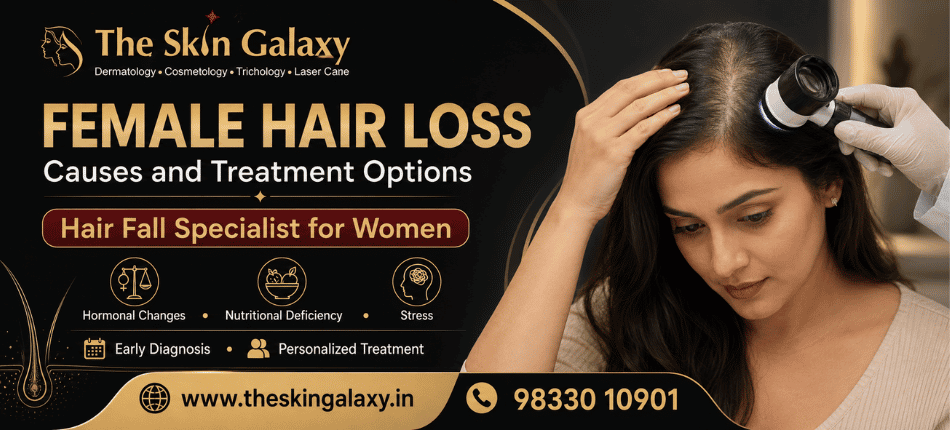
Female Hair Loss: Causes and Treatment Options | Hair Fall Specialist for Women – The Skin Galaxy
Hair loss can be emotionally distressing, especially when it affects confidence and appearance. While losing some hair every day is normal, excessive shedding, a widening hair part, reduced ponytail thickness or visible scalp may indicate an underlying hair or health condition.
Female hair loss can develop because of genetics, hormonal changes, nutritional deficiencies, stress, illness, medications or damaging hair-care practices. Since different causes require different treatments, consulting a qualified Hair Fall Specialist for Women is important before trying supplements or hair-growth products.
What Is Female Hair Loss?
Female hair loss refers to excessive shedding, reduced hair density or bald patches affecting women. It may develop gradually over several years or begin suddenly after a stressful physical or emotional event.
The American Academy of Dermatology notes that a widening part and reduced ponytail fullness are common early signs of hair loss in women. Female pattern hair loss is also considered one of the most common causes. American Academy of Dermatology
Common Signs of Female Hair Loss
Women may notice:
- Excessive hair on the pillow, floor or shower drain
- More hair coming out while combing
- A widening centre part
- Reduced thickness of the ponytail
- Increased scalp visibility
- Thinning over the crown
- Receding hair around the temples
- Smooth, circular bald patches
- Broken hair near the front or sides
- Redness, scaling, itching or scalp discomfort
Early evaluation can help identify the cause before the condition becomes more difficult to manage.
Common Causes of Female Hair Loss
1. Female Pattern Hair Loss
Female pattern hair loss, also called androgenetic alopecia, is a hereditary and progressive condition. It generally causes gradual thinning over the top and crown of the scalp, with the central part becoming wider.
Unlike male pattern baldness, women usually retain their frontal hairline and rarely develop complete baldness. Treatment is generally more effective when started during the early stages.
2. Hormonal Changes
Hormonal fluctuations can influence the hair-growth cycle. Hair loss may occur during:
- Pregnancy or after childbirth
- Menopause
- Polycystic ovary syndrome
- Thyroid disorders
- Changes in hormonal medication
Postpartum shedding commonly appears a few months after delivery and may gradually settle. Persistent hair loss, however, requires medical assessment.
3. Telogen Effluvium
Telogen effluvium is a temporary condition that causes excessive and widespread hair shedding. It may develop after severe stress, high fever, surgery, childbirth, rapid weight loss or nutritional deficiencies. Shedding commonly begins a few months after the triggering event. Hair growth may gradually recover once the underlying cause is identified and addressed, although improvement can take several months.
4. Iron and Nutritional Deficiencies
Insufficient iron, protein, vitamin B12, vitamin D or other essential nutrients may affect healthy hair growth. Women with heavy periods, restrictive diets or digestive disorders may have a higher risk of certain deficiencies.
Supplements should not be started blindly. A doctor may recommend blood tests and prescribe supplementation only when a deficiency is confirmed.
5. Alopecia Areata
Alopecia areata is an autoimmune condition in which the immune system attacks hair follicles. It commonly causes one or more smooth, round bald patches, although more extensive hair loss is possible.
A dermatologist may recommend topical medicines, injections or other treatments according to the patient’s age and extent of hair loss.
6. Traction Alopecia
Repeated pulling from tight ponytails, buns, braids, hair extensions or similar hairstyles can damage follicles. Early traction alopecia may improve after changing hairstyles, but long-term tension may lead to permanent loss.
Avoid hairstyles that cause pain, tightness or repeated pulling along the hairline.
7. Scalp Conditions
Dandruff, fungal infections, psoriasis and inflammatory scalp disorders may cause scaling, itching, breakage or hair loss. Treating the scalp condition can help create a healthier environment for hair growth.
Pain, pus, crusting, scarring or rapidly spreading patches should be assessed promptly.
8. Heat and Chemical Damage
Frequent straightening, bleaching, colouring and chemical treatments can weaken the hair shaft and cause breakage. Excessive use of high-temperature styling tools may make hair appear thinner even when the follicles remain active.
The AAD advises limiting heated styling tools and using the lowest suitable heat setting. Hair-care guidance from the AAD
Treatment Options for Female Hair Loss
Topical Treatment
Topical minoxidil is commonly used for female pattern hair loss. It may help reduce progression and support regrowth, but results require regular use and time. Some people experience temporary increased shedding when beginning treatment.
Minoxidil should be used under professional guidance, particularly during pregnancy, breastfeeding or when other medical conditions are present.
Prescription Medicines
Selected women may be prescribed medicines that address hormonal influence on hair follicles. These medicines are not suitable for everyone and require medical supervision because of possible side effects and pregnancy-related risks.
Treatment of Nutritional Deficiencies
When testing confirms iron or vitamin deficiency, appropriate supplementation and dietary changes may improve hair growth. Improvement is gradual because hair follicles require time to return to an active growth phase.
Treatment for Scalp Disorders
Anti-dandruff shampoos, antifungal treatment or anti-inflammatory medicines may be prescribed according to the diagnosis. Using random medicated shampoos without identifying the condition can delay effective care.
Platelet-Rich Plasma Therapy
PRP therapy involves processing a patient’s blood to obtain platelet-rich plasma and injecting it into selected areas of the scalp. It may be considered for suitable cases, but results vary and multiple sessions may be needed.
A specialist should first determine whether PRP is appropriate for the diagnosed type of hair loss.
Hair Transplantation
Hair transplantation may be considered for selected patients with stable, permanent hair loss and an adequate donor area. It is generally not the first treatment for active shedding or temporary hair loss.
When Should You Consult a Specialist?
Arrange an evaluation if hair loss is sudden, rapidly worsening, patchy or associated with scalp inflammation. You should also seek help when thinning continues for several months or affects your emotional well-being.
Because no single treatment works for every cause of hair loss, accurate diagnosis is the first and most important step.
Consult The Skin Galaxy
The Skin Galaxy provides professional evaluation and personalized treatment options for female hair loss. A consultation with a Hair Fall Specialist for Women can help identify the underlying cause and develop a suitable treatment plan.
Hair Fall Specialist for Women Hair Fall Specialist for Women Hair Fall Specialist for Women Hair Fall Specialist for Women Hair Fall Specialist for Women Hair Fall Specialist for Women Hair Fall Specialist for Women Hair Fall Specialist for Women