
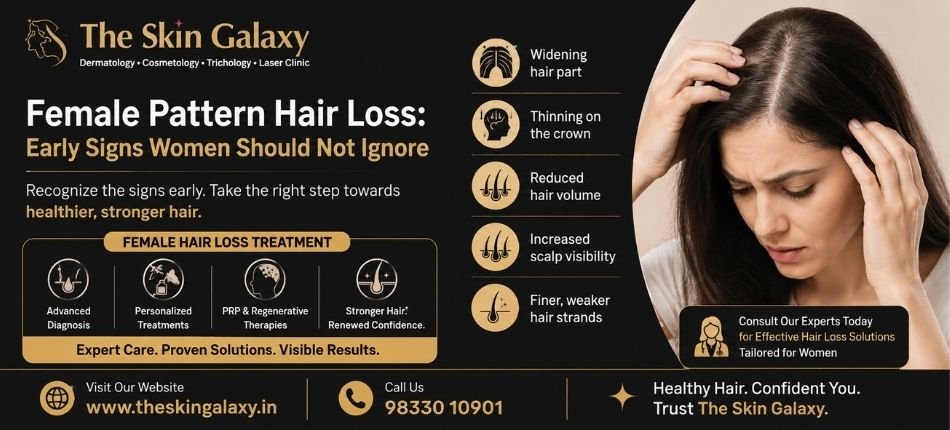
Female Pattern Hair Loss: Early Signs Women Should Not Ignore | Female Hair Loss Treatment – The Skin Galaxy
Introduction
Hair shedding is a normal part of the hair growth cycle, but when your hair gradually becomes thinner, your parting appears wider, or your scalp becomes increasingly visible, it may indicate an underlying hair loss condition.
One common cause of progressive hair thinning in women is female pattern hair loss (FPHL), also known as female androgenetic alopecia. Unlike sudden hair shedding, female pattern hair loss usually develops gradually, which means its early signs can easily go unnoticed.
Recognizing these changes and seeking professional evaluation can help identify the cause and determine suitable treatment options. If you are looking for Female Hair Loss Treatment in Mumbai, consulting a qualified dermatologist can help you understand why your hair is thinning and what can be done about it.
What Is Female Pattern Hair Loss?
Female pattern hair loss is a common form of progressive hair thinning in women. It usually affects the density of hair over the top and crown of the scalp while the frontal hairline may remain relatively preserved.
Hair follicles gradually produce finer, shorter hairs over time, leading to a noticeable reduction in hair volume.
The pattern can vary between individuals. Some women notice widening of the central part, while others experience more diffuse thinning across the top of the scalp.
What Are the Early Signs of Female Pattern Hair Loss?
Female pattern hair loss often progresses slowly. Paying attention to subtle changes can help you recognize a potential problem earlier.
1. Widening of the Hair Part
One of the most noticeable early signs is a gradually widening central hair part. You may notice that more scalp is visible when you part your hair in the same way you always have.
Comparing recent photographs with older ones can sometimes make this change easier to identify.
2. Reduced Hair Volume
Your ponytail may feel thinner than before, or hairstyles that previously looked full may start appearing flatter.
A gradual reduction in overall volume can occur even when you are not experiencing dramatic amounts of daily shedding.
3. Increased Scalp Visibility
As hair density decreases, the scalp may become increasingly visible under bright lights, sunlight, or when the hair is wet.
This is commonly noticed around the central or crown area.
4. Finer Hair Strands
Another characteristic change is that individual hairs may gradually become finer.
This process, known as follicular miniaturization, means affected follicles produce progressively thinner and shorter hairs.
5. Gradual Thinning Over the Crown
Unlike some forms of hair loss that create completely bald patches, female pattern hair loss typically causes progressive thinning over the top or crown.
This gradual progression is one reason women may overlook the condition initially.
What Causes Female Pattern Hair Loss?
Female pattern hair loss can be influenced by a combination of genetic, hormonal, and age-related factors.
A family history of pattern hair loss may increase susceptibility. Hormonal changes can also influence hair growth, particularly around menopause.
However, hair thinning in women has many possible causes, so visible thinning should not automatically be assumed to be female pattern hair loss.
Other Conditions That Can Cause Hair Loss in Women
Hair thinning or excessive shedding may also be associated with nutritional deficiencies, thyroid disorders, significant physical or emotional stress, recent illness, certain medications, postpartum hormonal changes, scalp disorders, or autoimmune conditions.
Another common condition is telogen effluvium, which typically causes increased diffuse shedding and may occur after illness, stress, nutritional changes, or other triggers.
Because different conditions can look similar, accurate diagnosis is important before beginning treatment.
How Is Female Pattern Hair Loss Diagnosed?
A dermatologist will typically evaluate the pattern and duration of hair loss and ask about factors such as family history, medications, diet, recent illness, menstrual or hormonal changes, and other symptoms.
The scalp and hair may then be examined for changes in density and hair-shaft thickness.
Depending on the clinical findings, additional investigations may sometimes be recommended to check for nutritional deficiencies, thyroid problems, hormonal factors, or other possible causes.
Treatment Options for Female Pattern Hair Loss
Treatment depends on the diagnosis, severity of hair loss, medical history, and individual requirements.
Topical Treatment
Topical minoxidil is commonly used for female pattern hair loss in appropriate patients. It can help maintain or improve hair density in some people, but results take time and continued treatment may be necessary to maintain benefits.
It should be used under appropriate medical guidance, particularly when pregnancy or certain medical conditions are relevant.
Oral Medications
In selected patients, a dermatologist may consider prescription medications depending on the individual’s clinical situation.
These treatments are not suitable for everyone and should only be taken following proper medical evaluation.
Correcting Nutritional Deficiencies
If testing identifies deficiencies such as iron deficiency, correcting them may form part of the treatment plan.
Supplements should ideally be taken based on a demonstrated need rather than assuming that every case of hair loss is caused by vitamin deficiency.
Procedural Options
Depending on the diagnosis and severity, dermatologists may discuss procedures such as platelet-rich plasma (PRP) therapy or other treatment approaches.
The suitability and expected benefit of these procedures vary between individuals, so they should be discussed as part of a personalized treatment plan.
Why Early Diagnosis Matters
Female pattern hair loss is generally progressive. Therefore, waiting until significant thinning has occurred may make management more challenging.
Early evaluation provides an opportunity to identify the type of hair loss, rule out other causes, and discuss appropriate management before further progression.
When Should You Consult a Dermatologist?
Consider seeking professional evaluation if you notice persistent excessive shedding, widening of your parting, visible scalp, progressive reduction in hair volume, bald patches, scalp itching or inflammation, or hair loss accompanied by other physical symptoms.
Sudden or rapidly progressing hair loss deserves particularly prompt evaluation.
Hair Loss Treatment in Mumbai at The Skin Galaxy
Hair loss treatment should begin with understanding why the hair loss is happening rather than choosing treatments based only on advertisements or online recommendations.
At The Skin Galaxy, patients experiencing hair thinning or excessive shedding can receive professional evaluation to determine the likely cause and discuss appropriate treatment options.
If you are searching for hair loss treatment in Mumbai, a personalized dermatological assessment can help establish a management plan suited to your hair and scalp condition.
Conclusion
Female pattern hair loss can begin with subtle signs such as a widening part, reduced hair volume, finer strands, and increasing scalp visibility.
Because many other conditions can also cause hair loss in women, self-diagnosis may lead to inappropriate treatment.
Recognizing the early signs and consulting a dermatologist can help identify the cause and guide appropriate management. If you are concerned about progressive hair thinning, consider consulting The Skin Galaxy for hair loss treatment in Mumbai.
Female Hair Loss Treatment Female Hair Loss Treatment Female Hair Loss Treatment Female Hair Loss Treatment Female Hair Loss Treatment Female Hair Loss Treatment Female Hair Loss Treatment Female Hair Loss Treatment Female Hair Loss Treatment Female Hair Loss Treatment Female Hair Loss Treatment Female Hair Loss Treatment Female Hair Loss Treatment