
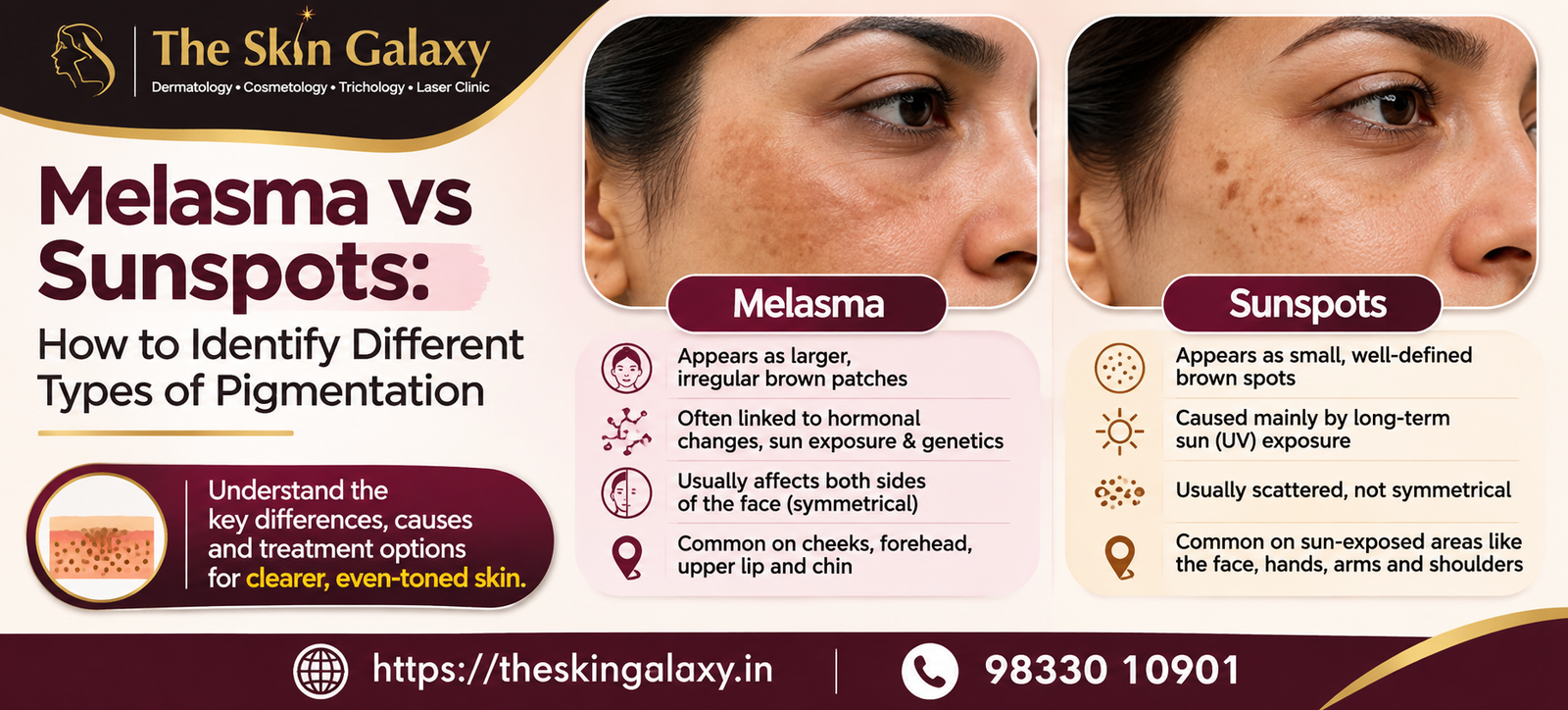
Melasma vs Sunspots: How to Identify Different Types of Pigmentation – The Skin Galaxy
Types of Skin Pigmentation can affect people of all ages and skin types. Melasma and sunspots are two common pigmentation concerns that cause dark patches, uneven skin tone, and facial discoloration. Understanding the differences between melasma and sunspots, their causes, symptoms, and treatment options can help you choose the right skincare approach.
Two frequently confused pigmentation conditions are melasma and sunspots. Although both can cause brown discoloration, they differ in their causes, appearance, distribution, and treatment approaches.
Understanding Melasma vs Sunspots can help you recognize the signs of different pigmentation conditions and determine when professional dermatological advice may be necessary.
At The Skin Galaxy, understanding the causes of pigmentation is an important step toward developing an appropriate skincare and treatment plan.
What Is Skin Pigmentation?
Skin pigmentation refers to the natural color of the skin, primarily determined by a pigment called melanin. Melanin is produced by specialized skin cells known as melanocytes.
When melanin production increases or pigment accumulates unevenly, certain areas of the skin may become darker than the surrounding skin. This condition is commonly called hyperpigmentation.
Several factors can contribute to pigmentation, including:
-
Excessive exposure to sunlight and ultraviolet (UV) radiation
-
Hormonal changes during pregnancy
-
Genetic predisposition
-
Skin inflammation and acne
-
Certain medications
-
Aging and accumulated sun damage
-
Irritation from unsuitable skincare products
Not all pigmentation conditions are the same. Identifying the specific type is important because treatment methods that work for one condition may not be suitable for another.
What Is Melasma?
Melasma is a common pigmentation disorder characterized by irregular brown, tan, or sometimes grayish patches, primarily appearing on the face.
It commonly affects the cheeks, forehead, bridge of the nose, upper lip, and chin. Melasma often develops symmetrically, meaning similar patches may appear on both sides of the face.
This condition is particularly common among women, although men can also develop melasma.
Melasma is associated with several contributing factors, including hormonal changes, genetic susceptibility, ultraviolet radiation, and visible light exposure.
Common Causes of Melasma
1. Hormonal Changes
Hormonal fluctuations during pregnancy or while taking certain hormonal medications can trigger or worsen melasma in susceptible individuals. This is why melasma is sometimes called the mask of pregnancy.
2. Sun Exposure
Ultraviolet radiation stimulates melanin production, making existing melasma patches darker and potentially contributing to new pigmentation.
3. Genetic Factors
People with a family history of melasma may be more likely to develop the condition. Genetic susceptibility can influence how the skin responds to sunlight and hormonal changes.
4. Visible Light and Heat
Visible light, particularly in darker skin tones, can contribute to melasma. Heat may also aggravate pigmentation in some individuals, although its role is less clearly established.
5. Skin Irritation
Harsh skincare products, excessive exfoliation, and irritating treatments may worsen pigmentation, especially in sensitive or darker skin types.
Common Symptoms of Melasma
Melasma typically appears as:
-
Brown or gray-brown patches on the face
-
Irregularly shaped areas of discoloration
-
Symmetrical pigmentation on both cheeks
-
Darkening after sun exposure
-
Persistent uneven skin tone
Melasma generally does not cause itching, pain, or physical discomfort.
American Academy of Dermatology+1
What Are Sunspots?
Sunspots, medically known as solar lentigines, are flat, pigmented spots that develop due to prolonged or repeated exposure to ultraviolet radiation.
They are also commonly called age spots or liver spots, although they are not caused by liver disease.
Unlike melasma, which usually forms larger patches, sunspots often appear as individual, clearly defined brown spots.
Sunspots are commonly found on areas frequently exposed to sunlight, including the face, hands, shoulders, arms, and upper back.
Common Causes of Sunspots
1. Long-Term Sun Exposure
Repeated exposure to ultraviolet radiation can increase pigmentation in certain areas of the skin, gradually producing visible sunspots.
2. Aging
Sunspots become more common with increasing age because UV-related skin damage accumulates over time.
3. Frequent Outdoor Activities
People who spend significant time outdoors without adequate sun protection may develop sunspots earlier.
4. Previous Sunburns
A history of significant sun exposure or sunburn can contribute to the development of solar lentigines.
Common Symptoms of Sunspots
Sunspots usually have the following characteristics:
-
Flat brown, tan, or dark spots
-
Clearly defined borders
-
Round, oval, or slightly irregular shapes
-
Appearance on sun-exposed areas
-
Gradual development over time
-
Little or no fading during winter
Sunspots are usually harmless, but a new or changing pigmented lesion should be examined to rule out other skin conditions.
DermNet®+1
Melasma vs Sunspots: Key Differences
Although melasma and sunspots both involve increased pigmentation, several characteristics can help distinguish them.
| Feature | Melasma | Sunspots |
|---|---|---|
| Appearance | Larger, irregular patches | Individual, defined spots |
| Main causes | Hormonal factors, sunlight, genetics | Cumulative UV exposure |
| Common locations | Cheeks, forehead, upper lip | Face, hands, arms, shoulders |
| Pattern | Often symmetrical | Usually scattered |
| Color | Light brown to gray-brown | Tan to dark brown |
| Age group | Common in younger and middle-aged adults | More common with increasing age |
| Hormonal influence | Often significant | Not usually a major factor |
| Recurrence | Frequently recurring | Treated spots may clear, but new ones can form |
| Treatment | Sun protection and prescription pigmentation treatments | Sun protection, topical treatments, or selected procedures |
These differences are useful clues, but appearance alone cannot reliably confirm a diagnosis.
How to Identify Melasma vs Sunspots on Your Face
Recognizing the pattern of pigmentation can help you understand whether your dark spots resemble melasma or sunspots.
1. Observe the Shape of the Pigmentation
Melasma commonly produces larger, irregular patches that may blend into surrounding skin.
Sunspots usually appear as smaller, distinct spots with more noticeable borders.
2. Check the Location
Melasma frequently affects both cheeks, the forehead, and the upper lip.
Sunspots can appear on the face but are also common on the hands, shoulders, and arms.
3. Consider Hormonal Changes
If pigmentation develops during pregnancy or after starting hormonal medication, melasma may be a possibility.
However, hormonal changes alone cannot confirm the condition.
4. Review Your Sun Exposure History
Long-term outdoor exposure may increase the likelihood of sunspots.
Melasma can also worsen significantly after sunlight exposure, making this factor relevant to both conditions.
5. Notice Whether the Spots Change
Melasma may become more noticeable after sun exposure and can fluctuate with hormonal changes.
Sunspots usually develop gradually and tend to remain visible throughout the year.
A dermatologist can evaluate these characteristics and determine whether further examination is required.
Other Types of Skin Pigmentation You Should Know
Melasma and sunspots are not the only causes of uneven skin tone. Several other conditions may produce similar discoloration.
1. Post-Inflammatory Hyperpigmentation (PIH)
Post-inflammatory hyperpigmentation occurs when the skin produces excess pigment after inflammation or injury.
Common triggers include acne, eczema, burns, insect bites, and irritating skincare products.
These dark marks usually appear in areas where the skin previously experienced inflammation.
2. Freckles
Freckles are small, flat, brown spots that commonly appear on sun-exposed skin.
They are often associated with genetic factors and may become darker during summer.
Unlike sunspots, freckles may fade considerably when sun exposure decreases.
3. Periorbital Pigmentation
Periorbital pigmentation refers to darkening around the eyes.
Possible contributing factors include genetics, allergies, rubbing, inflammation, and certain anatomical features.
Not all dark circles result from excess melanin, so treatment depends on the underlying cause.
4. Pigmentation Due to Skin Irritation
Repeated friction, harsh skincare ingredients, or excessive exfoliation can trigger inflammation and subsequent darkening.
This is particularly important for individuals with sensitive or pigmentation-prone skin.
5. Drug-Induced Pigmentation
Certain medications can cause changes in skin pigmentation.
The appearance and distribution vary depending on the medication and individual response.
A dermatologist may review your medication history when investigating unexplained pigmentation.
How Do Dermatologists Diagnose Melasma and Sunspots?
Accurate diagnosis is essential because different pigmentation conditions may require different treatment strategies.
1. Clinical Skin Examination
A dermatologist evaluates the location, color, pattern, borders, and distribution of pigmentation.
The examination may also include questions about sun exposure, skincare habits, medications, and hormonal changes.
2. Wood’s Lamp Examination
A Wood’s lamp uses ultraviolet light to help assess certain pigmentation patterns.
It may provide additional information about superficial pigmentation, although its usefulness varies with skin tone and the condition being evaluated.
3. Dermoscopy
Dermoscopy allows a dermatologist to examine skin structures and pigmentation patterns under magnification.
This technique can help distinguish benign pigmentation from lesions that require further investigation.
4. Additional Investigations
Most cases of melasma and typical sunspots can be diagnosed clinically.
If a spot has unusual features or there is concern about another condition, a dermatologist may recommend a skin biopsy or other appropriate investigations.
American Academy of Dermatology+1
Treatment Options for Melasma
Melasma management generally focuses on reducing excess pigmentation, controlling triggers, and preventing recurrence.
Because melasma can be persistent, treatment often requires patience and consistent skincare.
1. Broad-Spectrum Sunscreen
Daily sun protection is a fundamental part of melasma management.
Dermatologists generally recommend broad-spectrum sunscreen with SPF 30 or higher. Tinted sunscreens containing iron oxides may provide additional protection against visible light.
2. Topical Pigmentation Treatments
Depending on the patient’s skin type and pigmentation severity, dermatologists may prescribe or recommend ingredients such as:
-
Azelaic acid
-
Hydroquinone
-
Tretinoin
-
Kojic acid
-
Vitamin C
-
Prescription combination creams
Some treatments, particularly hydroquinone and steroid-containing combinations, require medical supervision and should not be used indefinitely without guidance.
3. Chemical Peels
Selected superficial chemical peels may help improve pigmentation in appropriate patients.
However, aggressive peeling can cause irritation and worsen pigmentation, especially in darker skin tones.
4. Laser and Light-Based Treatments
Certain laser procedures may be considered for selected cases of melasma.
These treatments require careful assessment because inappropriate settings can worsen pigmentation or cause recurrence.
5. Long-Term Maintenance
Melasma frequently requires ongoing management.
Even after visible improvement, consistent sunscreen use, gentle skincare, and appropriate maintenance treatment may help reduce recurrence.
American Academy of Dermatology+1
Treatment Options for Sunspots
Sunspots are generally benign and do not always require treatment. However, people seeking a more even skin tone may consider cosmetic treatment after a dermatologist confirms the diagnosis.
1. Topical Skincare Treatments
Selected topical treatments, including retinoids and pigment-reducing agents, may gradually improve the appearance of some sunspots.
Results depend on the depth and characteristics of the pigmentation.
2. Chemical Peels
Chemical peels may help reduce superficial pigmentation by promoting controlled exfoliation.
The treatment must be selected according to skin type and the nature of the spots.
3. Laser Treatment
Pigment-targeting lasers may be used to treat selected solar lentigines.
However, laser treatment can cause temporary or persistent changes in pigmentation, particularly in darker skin tones.
4. Intense Pulsed Light (IPL)
IPL may improve certain sun-related pigmentation changes in appropriately selected patients.
It is not suitable for every skin type or every pigmented lesion.
5. Cryotherapy
Cryotherapy uses controlled freezing to treat selected lesions.
It may be used for some sunspots but carries a risk of lighter or darker marks after treatment.
Important: A dermatologist should assess pigmented spots before cosmetic removal, especially if they are changing or have unusual features.
DermNet®+1
Can Melasma and Sunspots Be Prevented?
Although not every pigmentation condition can be completely prevented, appropriate skincare and sun protection can help reduce the risk of new spots and worsening discoloration.
1. Apply Sunscreen Every Day
Use a broad-spectrum sunscreen with SPF 30 or higher, even on cloudy days.
Reapply approximately every two hours when outdoors and after swimming or excessive sweating.
2. Avoid Excessive Sun Exposure
Seek shade during periods of intense sunlight.
Protective clothing, sunglasses, and wide-brimmed hats provide additional protection.
3. Follow a Gentle Skincare Routine
Avoid frequent harsh scrubbing, aggressive exfoliation, and products that cause burning or irritation.
A gentle cleanser and suitable moisturizer can help support the skin barrier.
4. Avoid Unsupervised Skin-Lightening Products
Some skin-lightening creams contain potent medications that may cause complications when used incorrectly.
Consult a dermatologist before starting strong pigmentation treatments.
5. Manage Existing Skin Conditions
Timely treatment of acne, eczema, and other inflammatory skin conditions may reduce the risk of post-inflammatory pigmentation.
6. Maintain Consistent Skincare
Pigmentation management often requires ongoing care rather than short-term treatment alone.
Consistency is especially important for individuals with recurring melasma.
American Academy of Dermatology+1
When Should You Consult a Dermatologist for Pigmentation?
While many pigmentation conditions are harmless, professional evaluation is recommended when:
-
Dark spots are increasing or spreading.
-
Pigmentation persists despite consistent sun protection.
-
New pigmentation develops without an obvious cause.
-
Skin discoloration appears after using certain skincare products.
-
Pigmentation is affecting your confidence or quality of life.
-
You are unsure whether the condition is melasma, sunspots, or another disorder.
Seek prompt medical assessment if a spot changes rapidly, develops multiple colors, bleeds, becomes painful, or has an unusual border. These changes should not automatically be assumed to be harmless pigmentation.
Why Consider The Skin Galaxy for Pigmentation Concerns?
Understanding the exact cause of pigmentation is an important part of selecting suitable skincare and treatment options.
At The Skin Galaxy, individuals concerned about melasma, sunspots, acne marks, and uneven skin tone can seek guidance on identifying pigmentation concerns and understanding potential treatment approaches.
A dermatology consultation may help with:
-
Identifying different types of pigmentation
-
Understanding possible causes and triggers
-
Evaluating skin type and sensitivity
-
Discussing suitable skincare and treatment options
-
Developing sun protection and maintenance strategies
Since every person’s skin is different, treatment decisions should be based on an individual assessment rather than a one-size-fits-all approach.
Conclusion
Understanding Melasma vs Sunspots is essential for identifying different types of skin pigmentation and selecting appropriate care.
Melasma generally appears as larger, irregular patches influenced by hormonal factors and sunlight, while sunspots are usually more defined marks associated with cumulative UV exposure.
Although both conditions may look similar, their treatment approaches and long-term management requirements can differ.
Daily sun protection, gentle skincare, and professional dermatological assessment play important roles in managing pigmentation.
If you are concerned about persistent dark patches, uneven skin tone, or sun-related pigmentation, consider consulting The Skin Galaxy for guidance on your skin concerns.
Healthy skin begins with understanding your skin.
Types of Skin Pigmentation Types of Skin Pigmentation Types of Skin Pigmentation Types of Skin Pigmentation Types of Skin Pigmentation Types of Skin Pigmentation Types of Skin Pigmentation Types of Skin Pigmentation Types of Skin Pigmentation Types of Skin Pigmentation Types of Skin Pigmentation Types of Skin Pigmentation Types of Skin Pigmentation Types of Skin Pigmentation Types of Skin Pigmentation Types of Skin Pigmentation Types of Skin Pigmentation Types of Skin Pigmentation Types of Skin Pigmentation Types of Skin Pigmentation Types of Skin Pigmentation Types of Skin Pigmentation Types of Skin Pigmentation Types of Skin Pigmentation Types of Skin Pigmentation Types of Skin Pigmentation Types of Skin Pigmentation