
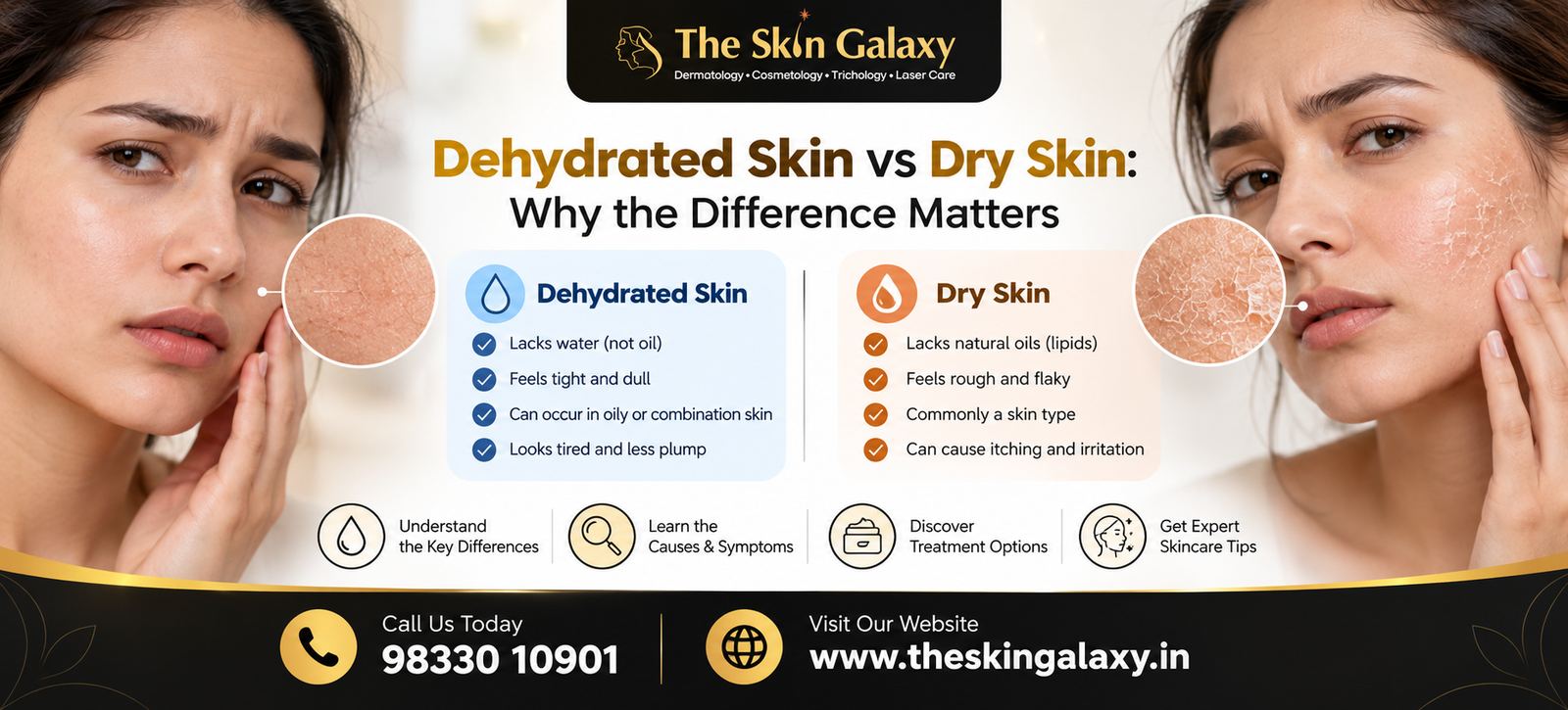
Dehydrated Skin vs Dry Skin: Why the Difference Matters | The Skin Galaxy
1. Introduction
Healthy, glowing skin depends on maintaining the right balance of moisture, natural oils, and a strong protective skin barrier. However, many people confuse dry skin with dehydrated skin because both can cause tightness, roughness, dullness, and discomfort. Understanding Dehydrated Skin vs Dry Skin is important because these conditions have different causes and may require different skincare approaches.
Dry skin is generally a skin type characterized by insufficient natural oils or lipids, while dehydrated skin is a condition in which the outer skin layers lack adequate water. Interestingly, even people with oily or acne-prone skin can experience dehydration, making it essential to identify the actual concern before selecting skincare products.
At The Skin Galaxy, understanding individual skin concerns is an important part of developing suitable skincare routines and treatment approaches. Whether you experience persistent dryness, temporary dehydration, sensitivity, or a weakened skin barrier, identifying the underlying cause can help improve skin comfort and appearance.
In this article, we will explore the differences between dehydrated skin and dry skin, their causes, symptoms, skincare ingredients, treatment options, and dermatologist-recommended habits for maintaining healthier skin.
2. What Is Dry Skin?
Dry skin, medically referred to as xerosis, occurs when the skin lacks sufficient moisture and protective lipids, often because its barrier does not retain water effectively.
Some people naturally produce less sebum, while others develop dry skin due to environmental conditions, ageing, frequent washing, or certain medical conditions.
Common signs of dry skin
-
Rough or flaky skin texture
-
Persistent tightness
-
Itching or irritation
-
Visible dry patches
-
Fine cracks in the skin
-
Increased sensitivity
-
Skin that feels uncomfortable after washing
Dry skin commonly affects the face, hands, arms, and legs. Symptoms may worsen during winter or in air-conditioned environments.
Important: Persistent dryness accompanied by redness, cracking, or severe itching may indicate eczema or another skin condition requiring medical evaluation.
3. What Is Dehydrated Skin?
Dehydrated skin is a condition in which the skin’s outer layers contain insufficient water.
Unlike dry skin, dehydration is not a fixed skin type. It can occur temporarily and affect people with dry, normal, combination, or oily skin.
When the skin barrier is disrupted, water can escape more easily through a process called transepidermal water loss (TEWL).
Common signs of dehydrated skin
-
Skin feels tight or uncomfortable
-
Dull or tired-looking complexion
-
Fine lines appearing more noticeable
-
Rough or uneven texture
-
Increased sensitivity
-
Temporary loss of skin plumpness
-
Oily areas combined with surface tightness
Dehydration can be associated with environmental exposure, harsh skincare products, excessive cleansing, or inadequate skin-barrier support.
Drinking sufficient water supports overall health, but skincare products and barrier care are often necessary when the problem involves moisture loss from the skin’s surface.
4. Dehydrated Skin vs Dry Skin: Key Differences
Although the symptoms overlap, the underlying characteristics are different.
| Feature | Dry Skin | Dehydrated Skin |
|---|---|---|
| Main concern | Reduced skin oils and impaired moisture retention | Insufficient water in the outer skin layers |
| Classification | Often a skin type; can also be a condition | Skin condition |
| Can affect oily skin? | Less typical as a skin type | Yes |
| Common appearance | Flaky, rough, scaly | Dull, tight, less plump |
| Common triggers | Genetics, ageing, cold weather, harsh cleansing | Barrier damage, dry air, over-exfoliation |
| Main skincare focus | Moisturizers and barrier-supporting lipids | Humectants, moisturizers and barrier repair |
| Treatment approach | Restore and maintain skin-barrier function | Improve water retention and address triggers |
Both conditions can occur together, which is why skincare should be selected according to symptoms and skin tolerance rather than labels alone.
5. Common Causes of Dry Skin
5.1 Genetics and Natural Skin Type
Some individuals naturally have skin that produces less sebum or is more prone to dryness.
5.2 Ageing
As skin ages, changes in sebum production and barrier function may contribute to dryness.
5.3 Cold Weather and Low Humidity
Cold air and low humidity can increase moisture loss, making skin feel rough and uncomfortable.
5.4 Frequent Washing
Repeated washing with hot water or harsh cleansers can remove protective oils from the skin.
5.5 Harsh Skincare Products
Strong soaps, alcohol-heavy products, and excessive exfoliation may worsen dryness and irritation.
5.6 Underlying Skin Conditions
Eczema, psoriasis, and other dermatological conditions can contribute to persistent dry or scaly skin.
6. Common Causes of Dehydrated Skin
6.1 Excessive Cleansing
Washing the face too frequently or using harsh cleansers can disrupt the protective skin barrier.
6.2 Over-Exfoliation
Frequent use of exfoliating acids, scrubs, or strong active ingredients may increase irritation and moisture loss.
6.3 Environmental Conditions
Dry air, air conditioning, cold weather, and low humidity can contribute to water loss from the skin.
6.4 Inadequate Moisturizing
Without suitable moisturizers, the skin may struggle to retain water effectively.
6.5 Sun Exposure
Excessive ultraviolet exposure can damage the skin barrier and contribute to dryness, irritation, and changes in skin appearance.
6.6 Certain Skincare Treatments
Products containing retinoids, benzoyl peroxide, or exfoliating acids may cause temporary dryness or irritation, particularly when introduced too quickly.
7. How to Identify Dehydrated Skin vs Dry Skin
Identifying whether your skin is dry, dehydrated, or both can help you select suitable products.
Check your skin texture
Dry skin often appears flaky or scaly, while dehydrated skin may feel tight and look dull without obvious flaking.
Observe your skin after cleansing
If your skin consistently feels rough and uncomfortable after washing, dryness or barrier irritation may be contributing.
Notice changes throughout the day
Dehydrated skin may feel tight even when the surface appears oily.
Evaluate your skincare routine
Frequent exfoliation, strong cleansers, and multiple active ingredients may contribute to skin-barrier disruption.
Consult a dermatologist
If symptoms persist, a dermatologist can assess whether the problem involves simple dryness, irritation, eczema, contact dermatitis, or another condition.
Note: Popular home tests such as pinching the skin are not reliable methods for distinguishing dry skin from dehydrated skin.
8. Why Does the Difference Between Dry Skin and Dehydrated Skin Matter?
Understanding Dehydrated Skin vs Dry Skin matters because choosing unsuitable skincare products may worsen irritation or fail to address the underlying concern.
For example, someone with naturally dry skin may benefit from a richer moisturizer containing ceramides and other barrier-supporting ingredients.
A person with oily but dehydrated skin may prefer a lightweight moisturizer containing humectants, such as glycerin or hyaluronic acid.
However, both conditions require adequate barrier support, and the same product may help with both.
Choosing products according to your skin’s needs can improve comfort, reduce unnecessary product use, and support healthier skin over time.
9. Best Skincare Ingredients for Dry Skin
9.1 Ceramides
Ceramides are lipids naturally present in the skin barrier. Products containing ceramides may help support barrier function and reduce moisture loss.
9.2 Glycerin
Glycerin is a humectant that attracts water and helps maintain hydration in the outer skin layers.
9.3 Petrolatum
Petrolatum forms a protective layer that reduces water loss and can be especially helpful for very dry or cracked skin.
9.4 Shea Butter
Shea butter acts as an emollient and can help soften rough, dry skin.
9.5 Dimethicone
Dimethicone is a skin-protecting ingredient that can reduce moisture loss and improve skin comfort.
9.6 Urea
Low-concentration urea formulations may help hydrate dry skin. Higher concentrations have exfoliating effects and may irritate sensitive or damaged skin.
10. Best Skincare Ingredients for Dehydrated Skin
10.1 Hyaluronic Acid
Hyaluronic acid is a humectant that helps attract and retain water in the skin.
10.2 Glycerin
Glycerin supports skin hydration and is suitable for many skin types.
10.3 Panthenol
Panthenol, also known as provitamin B5, is used in skincare formulations to support hydration and soothe irritated skin.
10.4 Ceramides
Ceramides help strengthen the skin’s protective barrier, reducing excessive water loss.
10.5 Squalane
Squalane is an emollient that helps soften the skin and support moisture retention.
10.6 Niacinamide
Niacinamide may help support skin-barrier function and improve certain concerns related to skin texture and irritation.
The best formulation depends on your skin type, sensitivity, and other skincare products.
11. Daily Skincare Routine for Dry Skin
A simple, consistent skincare routine can help manage dryness.
Morning routine
Step 1: Gentle Cleanser
Use a mild, fragrance-free cleanser or rinse with lukewarm water if appropriate for your skin.
Step 2: Moisturizer
Apply a moisturizer containing ingredients such as ceramides, glycerin, or petrolatum.
Step 3: Sunscreen
Use broad-spectrum SPF 30 or higher sunscreen.
Night routine
Step 1: Gentle Cleansing
Remove sunscreen and impurities without over-cleansing.
Step 2: Barrier-Supporting Moisturizer
Apply a suitable moisturizer while the skin is slightly damp.
Step 3: Extra Care for Dry Areas
For particularly dry patches, a thin layer of an appropriate occlusive moisturizer may help reduce overnight water loss.
Avoid introducing multiple strong active ingredients when the skin is irritated.
12. Daily Skincare Routine for Dehydrated Skin
Dehydrated skin generally benefits from gentle cleansing, hydration, and barrier protection.
Morning routine
-
Cleanse gently using a non-stripping cleanser.
-
Apply a hydrating product containing glycerin or hyaluronic acid if desired.
-
Use a moisturizer suitable for your skin type.
-
Finish with broad-spectrum SPF 30 or higher sunscreen.
Night routine
-
Remove makeup, sunscreen, and impurities gently.
-
Apply a hydrating serum if tolerated.
-
Use a moisturizer to support water retention.
-
Temporarily reduce irritating active ingredients if your skin feels sensitive.
A serum alone may not provide sufficient moisture retention, so pairing it with an appropriate moisturizer can be helpful.
13. Can Oily Skin Also Be Dehydrated?
Yes, oily skin can also become dehydrated because oil production and water content are different aspects of skin health. A person may have excess sebum on the surface while experiencing tightness, dullness, or irritation due to reduced water retention. Harsh cleansers, frequent exfoliation, and unsuitable skincare products can contribute to this imbalance. Using a lightweight, non-comedogenic moisturizer and gentle hydrating ingredients may help improve skin comfort without making the skin feel excessively greasy.
14. Common Skincare Mistakes That Worsen Dryness and Dehydration
Certain skincare habits can worsen both dry and dehydrated skin.
Using Harsh Face Washes
Strong cleansers may remove protective oils and contribute to irritation.
Washing With Very Hot Water
Hot water can worsen dryness by stripping the skin’s protective surface lipids.
Over-Exfoliating
Excessive scrubbing or frequent chemical exfoliation can disrupt the skin barrier.
Skipping Moisturizer
Even oily skin may benefit from regular moisturizing.
Using Too Many Active Ingredients
Combining several strong treatments can increase irritation and sensitivity.
Ignoring Sunscreen
Sun exposure can contribute to skin damage and worsen certain skin concerns.
Frequently Changing Products
Introducing many new products at once makes it difficult to identify which product causes irritation.
15. Professional Treatment for Dry and Dehydrated Skin
When basic skincare does not improve symptoms, a dermatologist can assess the skin and recommend appropriate treatment.
Skin Assessment
A dermatologist evaluates skin texture, sensitivity, irritation, medical history, and current skincare products.
Prescription Treatment
If eczema, contact dermatitis, or another inflammatory condition is present, prescription medication may be required.
Barrier Repair Recommendations
Suitable moisturizers and adjustments to cleansing or active ingredients can help support barrier recovery.
Treatment of Underlying Conditions
Persistent dryness may sometimes be related to medical conditions or medications that require further assessment.
Personalized Skincare Guidance
A dermatologist can recommend suitable products and routines based on skin type, symptoms, and treatment goals.
Cosmetic hydration treatments may improve the skin’s appearance in selected cases, but they are not automatically necessary for ordinary dry or dehydrated skin.
16. How Long Does It Take to Improve Dry or Dehydrated Skin?
The time required to improve dry or dehydrated skin depends on the underlying cause, severity, and consistency of skincare practices.
Mild dryness or dehydration may begin to improve within several days of gentle cleansing and regular moisturizing.
More significant barrier disruption may take several weeks to settle, particularly if irritation or inflammation is present.
Chronic conditions such as eczema may require ongoing management.
If symptoms worsen, involve painful cracks, or fail to improve with appropriate skincare, a dermatologist should evaluate the condition.
17. How to Prevent Dry and Dehydrated Skin
Maintaining healthy skin requires a combination of suitable skincare products and consistent daily habits. Use a gentle cleanser, avoid excessively hot water, and apply moisturizer regularly to support the protective skin barrier. Choose hydrating ingredients such as glycerin, hyaluronic acid, and ceramides according to your skin type. Limit over-exfoliation, protect your skin with broad-spectrum sunscreen, and avoid products that cause irritation. Consistent skincare and early attention to persistent symptoms can help maintain healthier, more comfortable skin.
18. When Should You Consult a Dermatologist?
If your skin remains excessively dry, dehydrated, or irritated despite following a proper skincare routine, it may be time to consult a dermatologist. Persistent itching, redness, flaking, burning sensations, or painful cracks can indicate an underlying skin condition such as eczema or contact dermatitis. A dermatologist can assess your skin type, identify possible causes, and recommend suitable Dry Skin and Dehydrated Skin Treatment based on your individual needs. Early consultation can help prevent further irritation, improve skin-barrier function, and restore skin comfort. For personalized skincare guidance and professional treatment options, consult The Skin Galaxy in Mumbai.
19. Dry and Dehydrated Skin Treatment in Mumbai – The Skin Galaxy
Dry and dehydrated skin can affect people of different ages and skin types. Understanding whether your skin needs improved hydration, barrier support, or treatment for an underlying condition is important for achieving better results.
At The Skin Galaxy, patients can seek guidance for common skincare concerns, including dryness, dehydration, sensitivity, and skin-barrier problems.
A personalized skincare approach may include evaluating current skincare products, identifying possible irritants, recommending appropriate moisturizers, and assessing whether additional dermatological treatment is needed.
For more information, visit The Skin Galaxy
Conclusion
Understanding Dehydrated Skin vs Dry Skin is an important step toward choosing an effective skincare routine.
While dry skin is often associated with reduced natural oils and impaired moisture retention, dehydrated skin involves insufficient water in the outer skin layers. Both conditions may cause tightness, dullness, roughness, and sensitivity, but their underlying causes can differ.
A gentle cleanser, appropriate moisturizer, suitable hydrating ingredients, and daily sunscreen can help support healthy skin.
For persistent dryness, dehydration, or sensitivity, professional dermatological assessment can help identify the underlying concern and guide appropriate treatment.
The Skin Galaxy provides a resource for individuals seeking guidance about skin health and skincare concerns in Mumbai.
Website: https://theskingalaxy.in/
Dehydrated Skin vs Dry Skin Dehydrated Skin vs Dry Skin Dehydrated Skin vs Dry Skin Dehydrated Skin vs Dry Skin Dehydrated Skin vs Dry Skin Dehydrated Skin vs Dry Skin Dehydrated Skin vs Dry Skin Dehydrated Skin vs Dry Skin Dehydrated Skin vs Dry Skin Dehydrated Skin vs Dry Skin Dehydrated Skin vs Dry Skin Dehydrated Skin vs Dry Skin Dehydrated Skin vs Dry Skin Dehydrated Skin vs Dry Skin Dehydrated Skin vs Dry Skin Dehydrated Skin vs Dry Skin Dehydrated Skin vs Dry Skin Dehydrated Skin vs Dry Skin Dehydrated Skin vs Dry Skin Dehydrated Skin vs Dry Skin Dehydrated Skin vs Dry Skin