
Fungal Acne or Regular Acne? How to Identify the Difference | Dermatologist for fungal acne – The Skin Galaxy
Small red bumps on the face, chest or back are often assumed to be ordinary acne. However, not every acne-like breakout is acne vulgaris. A condition commonly called “fungal acne” can produce similar-looking bumps but develops for a different reason and may require a different treatment approach.
Fungal acne is medically known as Malassezia folliculitis or Pityrosporum folliculitis. Despite its popular name, it is not a true form of acne. It occurs when Malassezia yeast, which normally lives on the skin, overgrows and affects the hair follicles. Regular acne, on the other hand, develops when follicles become blocked by excess oil and dead skin cells, with inflammation and bacteria also playing a role.
Because these conditions can appear similar—and may sometimes exist together—consulting a dermatologist for fungal acne is the safest way to obtain an accurate diagnosis.
What Is Fungal Acne?
Fungal acne is an infection or inflammation of the hair follicles associated with an overgrowth of Malassezia yeast. This yeast is normally present on human skin and does not always cause problems. Under certain conditions, however, it can multiply and enter the hair follicles, producing clusters of small papules or pustules.
Malassezia folliculitis frequently affects the upper back, chest, shoulders, hairline and forehead. The bumps often look similar in size and may be accompanied by noticeable itching. Medical references describe it as an itchy, acne-like eruption that commonly affects the upper body
What Is Regular Acne?
Regular acne, medically known as acne vulgaris, is a common skin condition that develops when hair follicles become blocked by excess sebum, dead skin cells and debris. Inflammation and the activity of Cutibacterium acnes bacteria may also contribute to breakouts. Acne can appear as blackheads, whiteheads, red pimples, pus-filled spots, nodules or cysts, commonly affecting the face, chest, shoulders and back. Hormonal changes, genetics, stress, certain medicines, oily cosmetics and unsuitable skincare products can influence its severity. Unlike fungal acne, regular acne usually produces different types and sizes of lesions, including comedones, and itching is generally not its main symptom.
Fungal Acne vs Regular Acne: Key Differences
Although photographs on social media may make the conditions appear easy to distinguish, visual appearance alone is not always enough. The following characteristics can provide useful clues but should not be treated as a confirmed diagnosis.
Cause
Fungal acne is associated with an overgrowth of Malassezia yeast inside hair follicles. Regular acne develops because follicles become blocked by oil and dead skin cells, followed by inflammation.
This difference is important because acne treatments do not automatically treat Malassezia folliculitis, while antifungal treatment is not appropriate for every ordinary acne breakout.
Appearance of the bumps
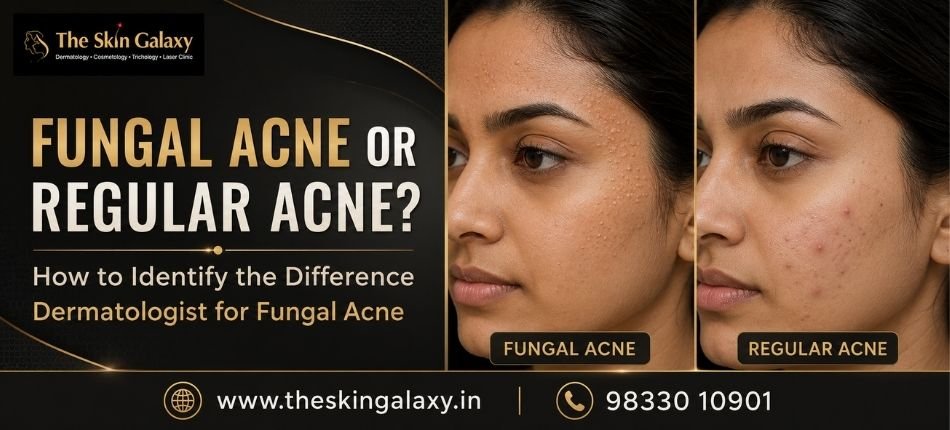
Fungal acne commonly produces many small bumps that appear relatively uniform in size and shape. This pattern is sometimes described as a monomorphic eruption.
Regular acne usually creates a mixture of lesions. A person may have blackheads, whiteheads, red pimples and deeper painful bumps at the same time.
Presence of itching
Itching is a frequently reported feature of Malassezia folliculitis. Regular acne is not typically dominated by itching, although inflamed skin may occasionally feel irritated or uncomfortable.
The American Academy of Dermatology notes that folliculitis can resemble a sudden acne breakout and may cause itching or pain.
Presence of blackheads and whiteheads
Comedones are a major feature of acne vulgaris. Blackheads develop when an open clogged follicle becomes exposed to air, while whiteheads form in closed clogged follicles.
Malassezia folliculitis generally does not produce true comedones. A breakout consisting of uniform itchy bumps without blackheads may therefore raise suspicion of folliculitis, but clinical examination is still necessary.
Commonly affected areas
Both conditions can affect the forehead, chest, shoulders and back. However, fungal acne is frequently seen on oily or sweat-prone areas of the upper body.
Regular acne is common on the face, particularly the forehead, nose, cheeks, chin and jawline, but it can also affect the chest and back.
Response to conventional acne treatment
When an acne-like breakout does not improve with an appropriate acne routine, the diagnosis may need to be reconsidered. In some cases, antibiotics can alter the skin’s microbial balance and may contribute to Malassezia overgrowth.
However, lack of improvement does not prove that a person has fungal acne. Resistant acne, bacterial folliculitis, medication-related eruptions and other skin conditions can also resemble one another.
Quick Comparison of Fungal Acne and Regular Acne
| Feature | Fungal acne | Regular acne |
|---|---|---|
| Medical name | Malassezia folliculitis | Acne vulgaris |
| Main mechanism | Yeast overgrowth affecting follicles | Blocked and inflamed follicles |
| Appearance | Uniform small papules or pustules | Mixed types and sizes of lesions |
| Itching | Common | Usually not a major symptom |
| Blackheads | Usually absent | Common |
| Whiteheads | True comedones generally absent | Common |
| Common areas | Chest, upper back, shoulders and forehead | Face, chest, shoulders and back |
| Treatment approach | Antifungal treatment when clinically appropriate | Acne-directed treatment |
| Diagnosis | Dermatological assessment; testing may be used | Usually clinical examination |
What Can Trigger Fungal Acne?
Several factors may create conditions in which Malassezia yeast can multiply more easily.
Heat, humidity and sweating
Warm, humid environments and persistent sweating may encourage yeast overgrowth. This is especially relevant for people who exercise frequently, wear tight clothing or remain in damp clothes for long periods.
Oily or occlusive products
Heavy creams, body oils and occlusive products may trap heat and moisture against the skin. Product-related breakouts can have several causes, so stopping products randomly is not always the best solution.
Tight or non-breathable clothing
Tight sportswear and synthetic fabrics may increase friction, warmth and sweating, particularly on the chest and back.
Antibiotic use
Prolonged or repeated antibiotic use may disrupt the normal balance of organisms on the skin. Antibiotics should not be stopped without guidance from the prescribing doctor.
A weakened immune system
Certain medical conditions and medicines that suppress immune function may increase susceptibility to folliculitis. Such patients should seek medical advice rather than attempting self-treatment.
Can Fungal Acne and Regular Acne Occur Together?
Yes. Malassezia folliculitis and acne vulgaris can exist at the same time. A person may have itchy, uniform bumps in one area and blackheads or inflammatory acne lesions in another.
This overlap is one reason internet photographs and home experiments may be misleading. Treating only one condition may provide partial improvement while the other continues.
How Does a Dermatologist Diagnose Fungal Acne?
A dermatologist will examine the size, distribution and appearance of the lesions and ask about itching, sweating, skincare products, recent medication use and previous acne treatments.
When the diagnosis is uncertain, the dermatologist may perform or recommend additional evaluation. A potassium hydroxide preparation may help identify yeast elements, while dermoscopy, Wood’s lamp examination or other testing may sometimes support the diagnosis. A 2025 medical review notes that diagnosis may be supported by methods such as dermoscopy, potassium hydroxide examination and Wood’s lamp evaluation
Tests are not required in every case. The choice depends on the clinical appearance and whether other conditions need to be excluded.
Conditions That Can Resemble Fungal Acne
Several skin conditions can cause similar bumps, including:
- Acne vulgaris
- Bacterial folliculitis
- Heat rash
- Keratosis pilaris
- Steroid-induced acneiform eruptions
- Contact dermatitis
- Rosacea
- Demodex folliculitis
Using an antifungal product on every itchy breakout can delay the correct diagnosis. Some rashes may worsen when treated with unsuitable products.
How Is Fungal Acne Treated?
Treatment depends on the severity, location, medical history and certainty of diagnosis. A dermatologist may recommend an appropriate topical or oral antifungal treatment. Predisposing factors such as sweating, occlusion and unsuitable skincare products may also need to be addressed.
DermNet notes that topical antifungal treatments can be effective, while recurrence may require maintenance measures in selected patients.
Oral antifungal medicines are prescription treatments and may not be suitable for everyone. They can interact with other medicines and may require medical precautions. They should never be started without professional advice.
Why Self-Diagnosis Can Be Misleading
Online advice often suggests that every itchy or uniform breakout is fungal acne. In reality, many follicular skin conditions can appear similar. Some people repeatedly change their routine or use strong antifungal products without knowing the actual diagnosis.
Incorrect treatment can cause dryness, irritation, delayed acne care or persistent symptoms. If bumps continue despite basic skincare, the better step is to consult a dermatologist instead of adding multiple active ingredients.
Skincare Tips That May Support Treatment
Along with dermatologist-recommended treatment, the following measures may help reduce irritation and recurrence:
- Shower after heavy sweating
- Change out of damp exercise clothing
- Wear breathable clothes when possible
- Avoid scratching or squeezing the bumps
- Use gentle, non-irritating skincare products
- Keep towels and exercise clothing clean
- Avoid sharing personal skincare items
- Follow the prescribed treatment for the recommended duration
These habits support medical treatment but do not replace it.
When Should You Consult a Dermatologist?
Consider consulting a dermatologist when:
- The breakout is itchy and persistent
- Bumps are spreading across the chest or back
- Ordinary acne treatment is not helping
- The breakout repeatedly returns
- Pain, crusting or discharge develops
- The skin is becoming scarred or deeply inflamed
- You are uncertain whether the condition is acne or folliculitis
- You have an underlying medical condition or take immune-suppressing medicines
Consult The Skin Galaxy
An accurate diagnosis is the first step towards choosing the right treatment. The specialists at The Skin Galaxy evaluate acne, folliculitis and other skin conditions before recommending a personalised management plan.
If you are looking for a dermatologist for fungal acne, consult The Skin Galaxy for a professional skin examination and treatment guidance.
Conclusion
Fungal acne and regular acne may look similar, but they develop through different mechanisms. Fungal acne commonly causes uniform, itchy bumps and generally lacks blackheads, while regular acne may include blackheads, whiteheads, pimples, nodules and cysts.
These clues can help patients recognise when a breakout needs further evaluation, but they cannot confirm the diagnosis. Consulting a dermatologist helps distinguish between Malassezia folliculitis, acne vulgaris and other acne-like conditions so that treatment can be selected safely.
Dermatologist for fungal acne Dermatologist for fungal acne Dermatologist for fungal acne Dermatologist for fungal acne Dermatologist for fungal acne Dermatologist for fungal acne Dermatologist for fungal acne Dermatologist for fungal acne Dermatologist for fungal acne Dermatologist for fungal acne Dermatologist for fungal acne Dermatologist for fungal acne Dermatologist for fungal acne Dermatologist for fungal acne Dermatologist for fungal acne Dermatologist for fungal acne Dermatologist for fungal acne Dermatologist for fungal acne