
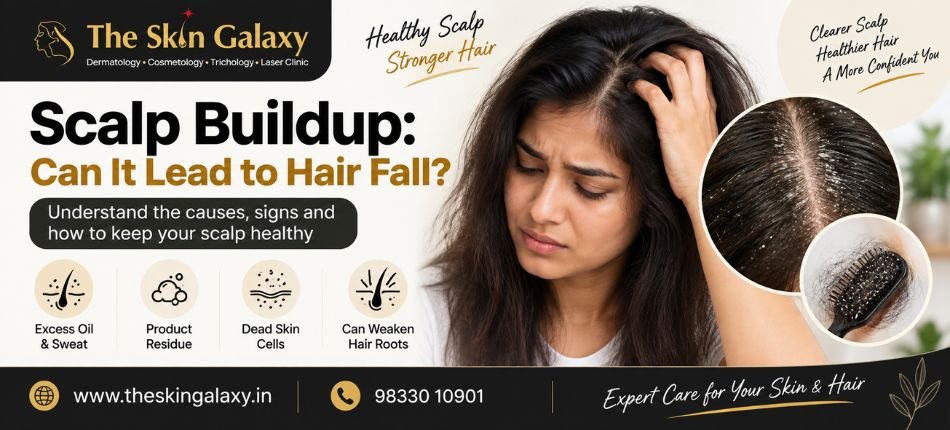
Scalp Buildup: Can It Lead to Hair Fall? – The Skin Galaxy
A healthy scalp provides the right environment for healthy-looking hair. However, oil, sweat, dead skin cells and residue from hair-care products can gradually collect on the scalp. This is commonly referred to as scalp buildup.
Many people notice itching, flakes, greasiness or an uncomfortable scalp along with increased shedding and wonder whether the two problems are connected. While scalp buildup itself does not necessarily cause permanent hair loss, conditions associated with excessive buildup—such as inflammation, dandruff or persistent scratching—may contribute to increased hair shedding or breakage.
Understanding the relationship between scalp buildup and hair fall can help you identify when simple changes in your hair-care routine may be enough and when professional evaluation is appropriate.
What Is Scalp Buildup?
Scalp buildup occurs when excess oil, dead skin cells, sweat, dirt, and hair-product residue accumulate on the scalp. It may make the scalp feel greasy, itchy, flaky, or uncomfortable. Frequent use of styling products and inadequate cleansing can contribute to buildup. Maintaining an appropriate scalp-cleansing routine can help keep the scalp clean and healthy.
What Causes Scalp Buildup?
Several factors can contribute to scalp buildup. Understanding the cause is important because not every flaky or greasy scalp should be treated in the same way.
1. Excess Sebum Production
Sebaceous glands naturally produce oil to protect the scalp. Some people naturally have an oilier scalp, while hormonal changes, environmental conditions and individual skin characteristics can also affect oil production.
When excessive sebum combines with dead skin cells and other debris, the scalp may feel greasy or coated.
2. Frequent Use of Styling Products
Hair sprays, serums, waxes, gels, leave-in conditioners and dry shampoos may leave residue behind, particularly when used frequently.
Repeated application without adequate cleansing can make the hair feel heavy, dull or sticky.
3. Inadequate Scalp Cleansing
Not washing the scalp adequately for your individual hair and scalp type can allow oil, sweat and dead skin cells to accumulate.
On the other hand, excessive or harsh washing can irritate the scalp. A balanced cleansing routine is therefore important.
4. Heavy Hair Oils and Conditioners
Applying large amounts of oil directly to the scalp or using rich conditioners near the roots may contribute to residue in some individuals, especially when the products are not thoroughly washed out.
5. Dandruff and Seborrheic Dermatitis
Persistent flakes are not always simply a hygiene issue. Dandruff and seborrheic dermatitis can cause scaling, itching and oily or dry-looking flakes.
These conditions may require targeted treatment rather than repeated aggressive cleansing.
6. Environmental Factors
Dust, pollution, sweat and humidity can mix with scalp oils and hair products, making buildup more noticeable.
People who exercise frequently or spend considerable time outdoors may need to adjust their cleansing routine accordingly.
What Does Scalp Buildup Look and Feel Like?
The appearance varies depending on its cause. Common signs can include:
- Greasy or oily roots
- Visible flakes
- Itchy scalp
- Hair that feels heavy or coated
- Unpleasant scalp odour
- Hair becoming oily soon after washing
- Residue visible around the roots
- Scalp irritation or sensitivity
- Dull-looking hair
If these symptoms continue despite appropriate cleansing, an underlying scalp condition may be responsible.
Can Scalp Buildup Lead to Hair Fall?
This is where the relationship between scalp buildup and hair fall needs to be understood carefully.
Scalp buildup does not automatically mean that your hair follicles will become permanently damaged. However, excessive buildup may occur alongside scalp inflammation, itching or dandruff. Persistent scratching can damage the hair shaft and may contribute to breakage.
Inflammatory scalp conditions can also sometimes be associated with increased shedding. Therefore, if you are experiencing substantial hair fall together with itching, scaling, redness or scalp discomfort, it is important to determine the underlying cause rather than assuming that buildup alone is responsible.
Hair fall can have many causes, including nutritional deficiencies, hormonal changes, stress, hereditary hair loss, illness, medications and thyroid disorders. A dermatologist can help distinguish between these possibilities.
Does Scalp Buildup Clog Hair Follicles?
People often describe buildup as “clogging” hair follicles. Sebum, dead skin and product residue can accumulate around follicular openings, but hair loss is more complicated than simply having blocked pores.
Hair growth occurs within follicles beneath the skin, and many biological factors regulate the hair-growth cycle.
Therefore, repeatedly scrubbing or trying to physically “unclog” follicles is not a reliable solution for hair loss and may actually irritate the scalp.
The goal should instead be to maintain a clean, comfortable scalp and appropriately treat any underlying dermatological condition.
How to Reduce Scalp Buildup Safely
Wash According to Your Scalp Type
There is no single ideal shampoo schedule for everyone. Someone with an oily scalp may need more frequent washing than a person with a dry or curly hair type.
Choose a cleansing frequency that keeps your scalp comfortable without causing excessive dryness or irritation.
Shampoo the Scalp Properly
Concentrate shampoo primarily on the scalp rather than aggressively rubbing the entire length of the hair.
Massage gently using your fingertips and rinse thoroughly to remove shampoo and loosened residue.
Avoid scratching the scalp with your fingernails.
Rinse Hair-Care Products Thoroughly
Incomplete rinsing can leave residue behind. Make sure shampoo and rinse-out conditioner are thoroughly removed.
Limit Excessive Styling Products
If you regularly use dry shampoo, hair spray, wax, serum or styling cream, monitor whether your scalp becomes greasy, itchy or coated.
Reducing unnecessary product layering may help.
Keep Conditioner Away From the Scalp When Appropriate
Many conditioners are intended mainly for the mid-lengths and ends of the hair. Applying heavy conditioner directly to an oily scalp may make the roots feel weighed down.
Avoid Aggressive DIY Scalp Scrubs
Physical scrubs, vigorous brushing, undiluted essential oils or harsh home remedies can irritate the scalp.
If significant scaling persists, professional evaluation is safer than repeatedly exfoliating the scalp.
Can Clarifying Shampoo Help?
Clarifying shampoos are formulated to remove heavier product residue and may be helpful for some people who regularly use styling products.
However, they are not necessarily suitable for frequent use. Strong cleansing ingredients may cause dryness or irritation, particularly on sensitive scalps.
A clarifying shampoo also does not treat every cause of flaking or hair fall. If the problem is due to dandruff, seborrheic dermatitis, psoriasis or another scalp disorder, specific treatment may be needed.
Scalp Buildup vs Dandruff: What Is the Difference?
These conditions can look similar but are not necessarily the same.
Scalp buildup often involves an accumulation of oil, sweat, dead skin and hair-product residue.
Dandruff is a common scalp condition characterized by flaking and sometimes itching. It is not simply the result of poor hygiene.
Because the symptoms can overlap, persistent or severe flaking is worth discussing with a dermatologist.
Can Hair Grow Normally After Scalp Buildup Is Treated?
If increased shedding or breakage is associated with a temporary scalp problem, improving scalp health and treating the underlying condition may help create a healthier environment for hair.
However, recovery depends on the actual cause of hair fall. For example, hereditary hair loss requires a different approach from dandruff-related inflammation or temporary shedding after illness.
This is why identifying the cause is more useful than treating every case of hair fall as a scalp-cleansing problem.
Tips for Maintaining a Healthy Scalp
Keep your scalp-care routine simple and consistent. Wash according to your scalp’s needs, rinse products properly, avoid excessive product layering and resist the temptation to scratch an itchy scalp.
Also clean combs, brushes, pillowcases and frequently used hair accessories regularly.
If you notice persistent changes in your scalp or hair density, early dermatological assessment can help determine what is happening and whether treatment is necessary.
Conclusion
The relationship between scalp buildup and hair fall is not always straightforward. Accumulated oil, dead skin cells, sweat and product residue can make the scalp uncomfortable and may coexist with conditions that cause itching, inflammation or increased shedding.
Good scalp hygiene can help control ordinary buildup, but persistent flaking, irritation or significant hair loss should not simply be treated with stronger shampoos or aggressive scrubbing.
If you are experiencing ongoing scalp concerns or unexplained hair fall, a consultation with a dermatologist at The Skin Galaxy can help identify the underlying cause and guide an appropriate scalp and hair-care plan
Scalp Buildup and Hair Fall Scalp Buildup and Hair Fall Scalp Buildup and Hair Fall Scalp Buildup and Hair Fall Scalp Buildup and Hair Fall Scalp Buildup and Hair Fall Scalp Buildup and Hair Fall Scalp Buildup and Hair Fall Scalp Buildup and Hair Fall Scalp Buildup and Hair Fall Scalp Buildup and Hair Fall Scalp Buildup and Hair Fall Scalp Buildup and Hair Fall Scalp Buildup and Hair Fall