
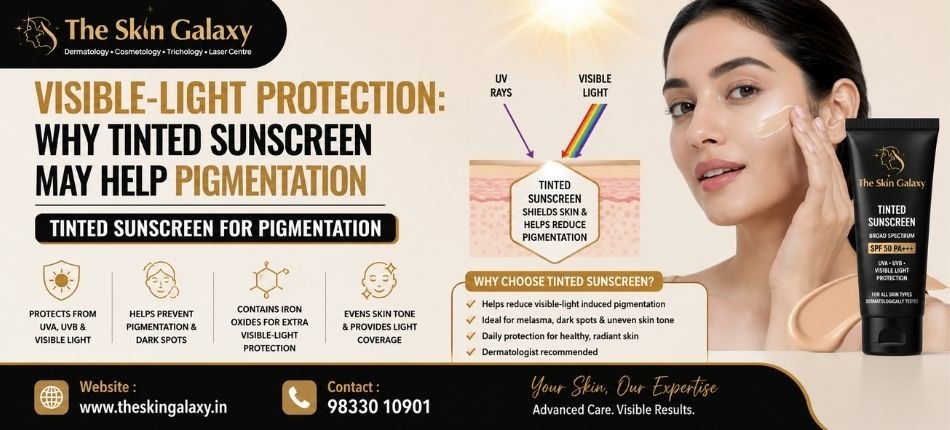
Visible-Light Protection: Why Tinted Sunscreen May Help Pigmentation | Tinted Sunscreen for Pigmentation – The Skin Galaxy
Most people know that sunscreen helps protect the skin from ultraviolet (UV) radiation. However, when it comes to concerns such as pigmentation, melasma and dark spots, UV protection may not be the only factor worth considering.
Visible light, particularly high-energy visible light, can also influence pigmentation in some skin types. This is one reason dermatologists may recommend tinted sunscreen for pigmentation, especially for people who are prone to melasma or persistent hyperpigmentation.
Unlike many traditional sunscreens, tinted sunscreens often contain pigments such as iron oxides. Along with providing cosmetic coverage, these pigments can help reduce the amount of visible light reaching the skin.
So, should you switch to tinted sunscreen if pigmentation is your main concern? Let’s understand the science, benefits and correct way to choose one.
What Is Visible Light?
Sunlight reaching our skin contains different forms of electromagnetic radiation. Ultraviolet radiation—including UVA and UVB—is well known for its effects on the skin.
However, sunlight also contains visible light, the portion of the spectrum that human eyes can see.
Research suggests that visible light may contribute to increased pigmentation, particularly in people with medium to deeper skin tones and those who are already prone to pigmentation disorders.
This means that protecting pigmentation-prone skin may sometimes require considering both UV radiation and visible light exposure.
How Can Visible Light Affect Pigmentation?
Visible light from sunlight can stimulate melanin production, particularly in people with medium to deeper skin tones or pigmentation-prone skin. This may contribute to the darkening of existing melasma, dark spots, and hyperpigmentation. For this reason, visible-light protection can be an important part of a pigmentation-focused skincare routine.
What Is Tinted Sunscreen?
Tinted sunscreen combines UV filters with coloured pigments, commonly including iron oxides. Along with protecting against UVA and UVB radiation, certain tinted formulations can provide additional protection against visible light. They may also offer light cosmetic coverage that helps even out the appearance of the skin.
Why Regular Sunscreen May Not Address All Visible Light
Broad-spectrum sunscreens are primarily designed to protect against UVA and UVB radiation.
Many non-tinted sunscreens may provide limited protection against visible light.
This is where tinted formulations containing appropriate pigments can offer an additional advantage.
Iron oxides help absorb and scatter portions of visible light, potentially reducing visible-light-induced pigmentation.
Therefore, when choosing sunscreen for hyperpigmentation, the ingredients and formulation can matter in addition to SPF.
Why Tinted Sunscreen May Help Pigmentation
A good pigmentation-management routine usually involves more than simply treating existing dark spots. Preventing further stimulation of pigment is also important.
Using tinted sunscreen for pigmentation may help by providing broader photoprotection.
1. Provides UV Protection
A broad-spectrum tinted sunscreen protects against UVA and UVB radiation when used correctly.
UV exposure can trigger or worsen many pigmentation concerns, making daily sun protection an important part of pigmentation management.
2. Offers Visible-Light Protection
The pigments used in certain tinted sunscreens, particularly iron oxides, can provide additional protection against visible light.
This may be especially beneficial for people prone to melasma and hyperpigmentation.
3. Helps Prevent Pigmentation From Becoming Darker
Consistent photoprotection can reduce repeated environmental stimulation that may make pigmentation more noticeable.
Sunscreen should therefore be considered part of both prevention and treatment-supportive skincare.
4. Provides Cosmetic Coverage
Tinted sunscreen can help temporarily camouflage uneven skin tone, dark spots and pigmentation.
This means you may receive sun protection and light cosmetic coverage from the same product.
What Are Iron Oxides in Tinted Sunscreen?
Iron oxides are pigments commonly used in cosmetics and tinted skincare products.
They usually appear as combinations of red, yellow and black iron oxides, which are blended to create different shades.
From a pigmentation perspective, their importance lies in their ability to help protect against portions of visible light.
This is why a dermatologist may recommend an iron-oxide-containing tinted sunscreen for patients dealing with melasma or persistent pigmentation.
Tinted Sunscreen for Melasma
Melasma commonly appears as brown or grey-brown patches, frequently affecting areas such as the cheeks, forehead, upper lip and nose.
Several factors can influence melasma, including sunlight, hormonal influences and individual susceptibility.
Because both UV radiation and visible light can influence pigmentation, comprehensive photoprotection is an important component of melasma management.
A suitable tinted sunscreen for melasma may therefore be recommended alongside other treatments prescribed by a dermatologist.
However, sunscreen itself is not a complete treatment for melasma.
Tinted Sunscreen for Post-Inflammatory Hyperpigmentation
Post-inflammatory hyperpigmentation, or PIH, refers to dark marks that can remain after inflammation or injury to the skin.
It may occur after:
- Acne
- Skin irritation
- Certain rashes
- Insect bites
- Scratching
- Some cosmetic procedures
Sun and light exposure may make existing pigmentation appear darker or prolong its visibility.
Consistent photoprotection can therefore play an important role while the skin gradually recovers.
Who May Benefit From Tinted Sunscreen?
Tinted sunscreen may be particularly useful for people dealing with:
- Melasma
- Uneven skin tone
- Post-acne marks
- Post-inflammatory hyperpigmentation
- Dark spots
- Sun-induced pigmentation
- Pigmentation-prone skin
However, the ideal sunscreen depends on your skin type, pigmentation concern, sensitivity and daily activities.
How to Choose a Tinted Sunscreen for Pigmentation
Choose a broad-spectrum tinted sunscreen with an appropriate SPF and consider formulations containing iron oxides for additional visible-light protection. The product should also suit your skin type—whether oily, dry, sensitive, or acne-prone—and have a tint you are comfortable applying consistently. For persistent melasma or hyperpigmentation, a dermatologist can recommend a suitable formulation.
How Much Sunscreen Should You Apply?
Applying too little sunscreen can reduce the level of protection you receive.
Use a generous, even layer over exposed areas and make sure commonly missed areas such as the ears, hairline and neck are protected when exposed.
Sunscreen should ideally be applied before significant sun exposure and reapplied according to the product instructions, particularly after sweating, swimming or wiping the face.
Is Tinted Sunscreen Only for Women?
No.
Tinted sunscreen is a photoprotection product, not a gender-specific cosmetic.
Men and women with pigmentation concerns can use tinted sunscreen if the formulation and shade suit their skin.
Many modern tinted sunscreens are designed to blend naturally into the skin without creating a heavy makeup-like appearance.
Can Tinted Sunscreen Remove Pigmentation?
Tinted sunscreen should not be considered a pigmentation-removal treatment.
Its primary role is photoprotection. It may help reduce environmental triggers that can worsen pigmentation and can complement treatments prescribed for the underlying condition.
Existing pigmentation may require additional management depending on its cause.
A dermatologist may recommend topical treatments, procedures or other approaches after examining your skin.
Common Sunscreen Mistakes to Avoid
Even an excellent sunscreen cannot provide adequate protection if it is used incorrectly.
Common mistakes include:
- Applying too little
- Using sunscreen only during summer
- Skipping sunscreen on cloudy days
- Applying sunscreen only when going outdoors for long periods
- Forgetting exposed areas
- Not reapplying when necessary
- Depending only on sunscreen while ignoring other sun-protection measures
Protective clothing, shade, hats and avoiding unnecessary intense sun exposure can complement sunscreen use.
When Should You Consult a Dermatologist for Pigmentation?
Consult a dermatologist if pigmentation is persistent, rapidly changing, recurring or difficult to manage with basic skincare.
Professional evaluation is particularly useful when you are unsure whether the pigmentation is due to melasma, acne marks, sun damage or another skin condition.
Correct diagnosis helps determine whether tinted sunscreen alone is sufficient as preventive care or whether additional treatment is required.
Conclusion
Sunscreen remains one of the most important steps in any pigmentation-focused skincare routine. But for people dealing with melasma, hyperpigmentation and persistent dark spots, considering visible-light protection may provide an additional advantage.
A tinted sunscreen for pigmentation, particularly one formulated with suitable pigments such as iron oxides, may offer protection against UV radiation while also helping reduce exposure to visible light.
Remember that pigmentation can have many different causes. Sunscreen supports pigmentation management, but it does not replace professional diagnosis and treatment.
For persistent pigmentation, melasma, dark spots or uneven skin tone, consult The Skin Galaxy for personalised skin assessment and an appropriate skincare and treatment plan.
Tinted Sunscreen for Pigmentation Tinted Sunscreen for Pigmentation Tinted Sunscreen for Pigmentation Tinted Sunscreen for Pigmentation Tinted Sunscreen for Pigmentation Tinted Sunscreen for Pigmentation Tinted Sunscreen for Pigmentation Tinted Sunscreen for Pigmentation Tinted Sunscreen for Pigmentation Tinted Sunscreen for Pigmentation Tinted Sunscreen for Pigmentation Tinted Sunscreen for Pigmentation