
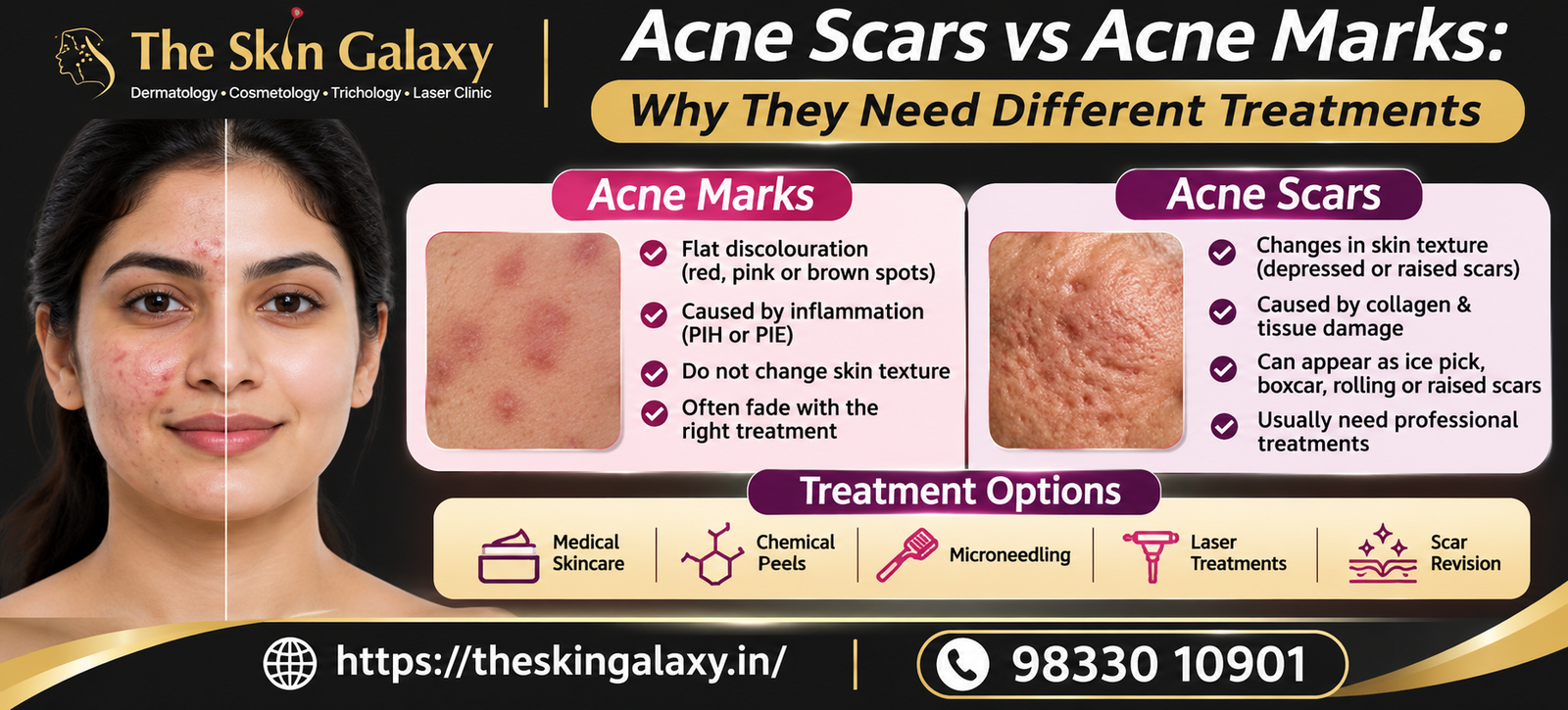
Acne Scars vs Acne Marks: Why They Need Different Treatments – The Skin Galaxy
Acne is a common skin condition that affects teenagers and adults. While active pimples may eventually heal, they often leave behind dark spots, redness, or uneven skin texture. Many people assume that these changes are the same and can be treated using similar skincare products. However, acne scars and acne marks are different skin concerns that require different treatment approaches.
Understanding Acne Scars vs Acne Marks is essential for choosing the right skincare routine and dermatological treatment. While acne marks primarily affect skin colour, acne scars involve structural changes in the skin caused by damage to collagen during the healing process.
At The Skin Galaxy, individuals experiencing persistent acne marks, pigmentation, and uneven skin texture can seek professional dermatological guidance to understand their skin concerns and explore suitable treatment options.
What Are Acne Marks?
Acne marks are flat areas of skin discolouration that develop after acne lesions heal. They occur when inflammation affects melanin production or blood vessels in the skin.
Unlike acne scars, acne marks generally do not cause permanent changes in skin texture. They may gradually fade over time, although some marks can persist for several months or longer.
Types of Acne Marks
1. Post-Inflammatory Hyperpigmentation (PIH)
Post-inflammatory hyperpigmentation occurs when the skin produces excess melanin following inflammation caused by acne. These marks usually appear brown, dark brown, or greyish and are particularly common in individuals with medium to darker skin tones.
Sun exposure, picking pimples, and using irritating skincare products may make pigmentation more noticeable or persistent.
2. Post-Inflammatory Erythema (PIE)
Post-inflammatory erythema appears as pink, red, or purplish marks after acne heals. These marks are associated with changes in small blood vessels and residual inflammation rather than excess melanin production.
PIE may gradually improve, but persistent redness may require a different treatment approach from dark acne marks.
What Are Acne Scars?
Acne scars develop when inflammation damages the deeper layers of the skin and disrupts normal collagen production during healing.
When the skin produces insufficient collagen, depressed or indented scars may form. When excess collagen is produced, raised scars can develop.
Unlike acne marks, acne scars involve changes in skin structure and texture. They generally do not disappear completely on their own and may require professional dermatological procedures to improve their appearance.
Different Types of Acne Scars
1. Ice Pick Scars
Ice pick scars are narrow, deep indentations that resemble small punctures in the skin. Because they extend into deeper skin layers, they can be difficult to improve with topical skincare products alone.
2. Boxcar Scars
Boxcar scars are round or oval depressions with clearly defined edges. They may develop when inflammatory acne damages collagen and supporting skin tissue.
3. Rolling Scars
Rolling scars create a wavy or uneven appearance on the skin. They often develop when fibrous bands beneath the skin pull the surface downward.
4. Hypertrophic Scars
Hypertrophic scars are raised scars that develop when the skin produces excess collagen during healing. They remain within the boundaries of the original skin injury.
5. Keloid Scars
Keloids are raised scars that can grow beyond the original acne lesion. They may require specialized dermatological treatment to manage their size, appearance, and associated discomfort.
Acne Scars vs Acne Marks: What Is the Difference?
Although both conditions develop after acne, their appearance, causes, healing process, and treatment requirements differ significantly.
| Particulars | Acne Marks | Acne Scars |
|---|---|---|
| Appearance | Flat dark, red or pink spots | Depressed, uneven or raised skin |
| Main cause | Pigmentation or vascular changes | Collagen and tissue damage |
| Skin texture | Generally unchanged | Noticeably altered |
| Healing time | May fade over several months | Often long-lasting |
| Natural recovery | Frequently improves over time | Usually limited |
| Skincare products | May help reduce discolouration | Limited effect on established structural scars |
| Professional treatments | Topical treatments, chemical peels or selected lasers | Microneedling, subcision, fractional lasers or other procedures |
| Treatment objective | Improve skin tone | Improve skin texture and scar appearance |
Correctly identifying whether you have acne marks, acne scars, or a combination of both is important before beginning treatment.
Common Causes of Acne Scars and Acne Marks
Several factors can increase the likelihood of developing pigmentation and scarring after acne.
1. Severe Inflammatory Acne
Deep, painful acne, including nodules and cysts, can damage surrounding skin tissue. Prolonged inflammation increases the likelihood of collagen damage and permanent scarring.
2. Picking or Squeezing Pimples
Frequently touching, squeezing, or scratching pimples can increase inflammation, damage surrounding skin, and interfere with natural healing. This may result in persistent pigmentation and acne scars.
3. Delayed Acne Treatment
Ignoring persistent or severe acne allows inflammation to continue for longer periods. Early dermatological treatment can help control active acne and reduce the risk of developing new scars.
4. Excessive Sun Exposure
Ultraviolet radiation can worsen post-inflammatory hyperpigmentation and make existing dark acne marks more noticeable. Regular sun protection is important for managing pigmentation.
5. Genetic Factors
Some individuals are naturally more prone to developing acne scars, pigmentation, or raised scars because of genetic factors and differences in their skin’s healing response.
6. Incorrect Skincare Products
Using harsh scrubs, strong exfoliating products, or unsuitable skincare treatments can irritate the skin and worsen inflammation, potentially making acne marks more persistent.
Why Do Acne Scars and Acne Marks Need Different Treatments?
Understanding Acne Scars vs Acne Marks helps explain why a single skincare product or procedure may not effectively address both conditions.
Acne marks primarily involve changes in pigmentation or blood vessels. Their treatment focuses on reducing discolouration, controlling inflammation, and improving overall skin tone.
Acne scars, on the other hand, involve structural damage beneath the skin’s surface. Their treatment focuses on collagen remodelling, releasing scar tissue, or improving uneven skin texture.
For example, a pigmentation-reducing cream may help fade dark acne marks but cannot significantly correct deep ice pick scars. Similarly, a procedure designed to improve depressed scars may not be the most appropriate first-line treatment for flat pigmentation.
A dermatologist can assess the type of skin damage and recommend a personalized treatment plan.
Effective Treatment Options for Acne Marks
Acne mark treatment focuses on reducing discolouration and promoting a more even skin tone. The appropriate treatment depends on whether the marks are caused by pigmentation or vascular changes.
1. Topical Vitamin C
Vitamin C is an antioxidant that may help reduce the appearance of hyperpigmentation and improve overall skin brightness. It should be introduced gradually, particularly in individuals with sensitive or acne-prone skin.
2. Niacinamide
Niacinamide may help support the skin barrier, reduce inflammation, and improve uneven pigmentation. It can be a useful ingredient in a dermatologist-recommended skincare routine.
3. Azelaic Acid
Azelaic acid can help manage active acne and post-inflammatory hyperpigmentation. It may be particularly beneficial for individuals experiencing persistent dark acne marks.
4. Topical Retinoids
Retinoids help regulate skin cell turnover and manage acne. They may also gradually improve post-inflammatory pigmentation. However, they can cause irritation and should generally be avoided during pregnancy.
5. Chemical Peels
Superficial chemical peels may help improve selected types of acne pigmentation by promoting controlled exfoliation. The type and strength of the peel should be selected according to the patient’s skin type and sensitivity.
6. Laser and Light-Based Treatments
Selected laser or light-based treatments may help improve persistent pigmentation or post-inflammatory redness. Different devices target different skin concerns, and unsuitable treatment can worsen pigmentation, especially in darker skin tones.
7. Regular Sunscreen Application
Using a broad-spectrum sunscreen with SPF 30 or higher helps protect the skin from ultraviolet damage and prevent existing acne pigmentation from becoming darker.
Effective Treatment Options for Acne Scars
Acne scar treatments focus on improving skin texture, stimulating collagen production, and reducing the appearance of structural skin damage.
1. Microneedling
Microneedling involves creating controlled micro-injuries in the skin to stimulate its natural healing response and collagen production. It may help improve certain depressed acne scars and uneven skin texture over multiple sessions.
2. Fractional Laser Resurfacing
Fractional laser treatments target selected areas of the skin to stimulate collagen remodelling. They may improve the appearance of certain boxcar and rolling scars.
Treatment intensity, recovery time, and potential pigmentation risks vary depending on the laser technology and individual skin type.
3. Radiofrequency Microneedling
Radiofrequency microneedling combines controlled microneedling with radiofrequency energy to stimulate collagen remodelling in deeper skin layers. It may be considered for selected patients with depressed acne scars.
4. Subcision
Subcision is a dermatological procedure used to release fibrous bands beneath depressed scars. It is particularly useful for selected rolling scars that are tethered to underlying tissue.
5. TCA CROSS Treatment
TCA CROSS involves the controlled application of trichloroacetic acid to individual scars. It may be recommended for selected deep ice pick scars and narrow boxcar scars.
This procedure must be performed by a qualified medical professional because incorrect application can cause burns, pigmentation, and additional scarring.
6. Dermal Fillers
Dermal fillers may help elevate certain depressed acne scars and improve skin contour. Results and duration vary depending on the filler used and the type of scar being treated.
7. Treatment for Raised Acne Scars
Hypertrophic and keloid scars require a different approach from depressed scars. Dermatologists may recommend corticosteroid injections, silicone-based treatments, or other appropriate procedures depending on the scar’s characteristics.
Which Treatment Is Suitable for Different Acne Scars and Marks?
| Skin Concern | Potential Treatment Options |
|---|---|
| Brown acne marks | Azelaic acid, topical retinoids, sunscreen, selected chemical peels |
| Red acne marks | Gentle skincare, selected vascular laser treatments |
| Ice pick scars | TCA CROSS, punch techniques |
| Boxcar scars | Fractional lasers, microneedling, selected punch techniques |
| Rolling scars | Subcision, microneedling, selected fillers |
| Hypertrophic scars | Corticosteroid injections, silicone-based treatments |
| Keloid scars | Specialized dermatological treatment |
| Uneven skin texture | Microneedling, fractional resurfacing |
Some patients have multiple types of acne scars and marks. In such cases, a combination of treatments may be recommended for better overall improvement.
How Long Does It Take for Acne Scars and Acne Marks to Heal?
The recovery period depends on the severity of skin damage, skin type, treatment method, and individual healing response.
| Skin Concern | Approximate Improvement Period |
|---|---|
| Mild dark acne marks | Several weeks to months |
| Persistent hyperpigmentation | Several months or longer |
| Red acne marks | Several months or longer |
| Mild depressed acne scars | Gradual improvement over multiple treatment sessions |
| Deep acne scars | Several months of personalized treatment |
| Raised acne scars | Variable, depending on severity and treatment response |
These timelines are approximate. Complete removal of acne scars cannot be guaranteed, but suitable treatment may significantly improve their appearance.
Daily Skincare Routine for Acne-Prone Skin
Following a consistent skincare routine can help manage active acne, protect the skin barrier, and prevent existing acne marks from becoming more noticeable.
Morning Skincare Routine
-
Wash your face with a gentle facial cleanser.
-
Apply a suitable antioxidant or dermatologist-recommended serum.
-
Use a lightweight, non-comedogenic moisturizer.
-
Apply broad-spectrum sunscreen with SPF 30 or higher.
Night Skincare Routine
-
Remove makeup and cleanse the skin gently.
-
Apply dermatologist-recommended acne or pigmentation treatment.
-
Use a suitable moisturizer to support the skin barrier.
-
Avoid excessive exfoliation and combining multiple strong active ingredients without guidance.
A skincare routine should be customized according to skin type, acne severity, sensitivity, and existing skin concerns.
Common Mistakes to Avoid When Treating Acne Scars and Acne Marks
Many individuals unknowingly worsen their skin concerns by following unsuitable skincare practices or unverified remedies.
Common mistakes include:
-
Treating acne scars and acne marks as the same condition.
-
Frequently squeezing or picking pimples.
-
Applying lemon juice, toothpaste, or harsh home remedies.
-
Using strong chemical peels without professional supervision.
-
Skipping daily sunscreen application.
-
Using too many active skincare ingredients simultaneously.
-
Expecting immediate results from pigmentation treatments.
-
Performing deep microneedling at home.
-
Ignoring active inflammatory acne.
-
Choosing cosmetic procedures without understanding their risks.
Avoiding these mistakes can help protect the skin barrier and reduce the risk of further pigmentation and scarring.
How to Prevent Acne Scars and Acne Marks
Although acne-related skin damage cannot always be prevented, appropriate skincare and timely treatment can help reduce the risk.
Treat Active Acne Early
Early treatment of inflammatory acne can help prevent deeper tissue damage and reduce the likelihood of permanent scarring.
Avoid Picking Pimples
Allow acne lesions to heal naturally rather than squeezing or scratching them. Picking can increase inflammation and interfere with the skin’s healing process.
Protect Your Skin from Sun Exposure
Regular sunscreen application can help prevent post-inflammatory pigmentation from becoming darker and protect the skin during dermatological treatment.
Choose Non-Comedogenic Skincare Products
Use skincare and cosmetic products formulated to minimize pore blockage. Avoid products that cause excessive dryness or irritation.
Consult a Dermatologist
Professional skin assessment can help identify the underlying causes of acne and determine appropriate treatment before permanent scars develop.
Common Myths About Acne Scars vs Acne Marks
| Myth | Fact |
|---|---|
| All acne marks are permanent. | Many acne marks gradually fade over time. |
| Acne scars and acne marks are the same. | Acne marks affect skin colour, while scars affect skin structure. |
| Face creams can remove deep acne scars. | Established deep scars often require professional procedures. |
| Scrubbing removes acne pigmentation. | Harsh scrubbing may worsen irritation and pigmentation. |
| Laser treatment is suitable for everyone. | Treatment suitability depends on skin type and scar characteristics. |
| One treatment session removes all acne scars. | Multiple sessions or combined treatments may be necessary. |
| Sunscreen is unnecessary for acne-prone skin. | Sun protection helps manage pigmentation and protects the skin. |
When Should You Consult a Dermatologist?
You should consider consulting a dermatologist if you experience persistent acne, deep or painful pimples, long-lasting pigmentation, depressed scars, raised scars, or uneven skin texture.
Professional evaluation is particularly important when over-the-counter skincare products fail to provide improvement or when previous treatments cause irritation and worsening pigmentation.
A dermatologist can identify the specific type of acne-related skin damage and recommend suitable treatment based on your skin condition, medical history, and treatment goals.
Why Choose The Skin Galaxy for Acne Scars and Acne Marks Treatment?
Managing acne-related skin concerns requires an accurate diagnosis and an individualized treatment approach. Since every person’s skin type, pigmentation, and scar pattern are different, treatment should be selected according to individual requirements.
At The Skin Galaxy, patients can seek professional dermatological guidance for concerns such as:
-
Active acne and breakouts
-
Post-inflammatory hyperpigmentation
-
Persistent red acne marks
-
Depressed and raised acne scars
-
Uneven skin texture
-
Acne-related skin discolouration
-
Personalized skincare routines
Understanding Acne Scars vs Acne Marks through professional skin assessment can help patients make informed decisions about their treatment and work towards healthier, clearer-looking skin.
Frequently Asked Questions (FAQs)
1. What is the main difference between acne scars and acne marks?
Acne marks are flat areas of skin discolouration, while acne scars involve structural changes in the skin caused by collagen and tissue damage.
2. Can acne marks disappear naturally?
Yes, many acne marks gradually fade naturally over several months. However, persistent pigmentation may benefit from appropriate dermatological treatment.
3. Can acne scars be removed permanently?
Acne scars can often be improved significantly with suitable treatment. However, complete removal cannot be guaranteed.
4. Is microneedling effective for acne scars?
Microneedling may help improve selected types of depressed acne scars by stimulating collagen production and supporting skin remodelling.
5. Can chemical peels remove acne marks?
Superficial chemical peels may help reduce certain types of post-inflammatory pigmentation. Their suitability depends on skin type and the severity of pigmentation.
6. Does sunscreen help reduce acne marks?
Sunscreen helps prevent existing pigmentation from becoming darker and supports the effectiveness of pigmentation treatments.
7. Can vitamin C remove acne scars?
Vitamin C may help improve pigmentation and overall skin brightness, but it cannot significantly correct established deep structural acne scars.
8. How many treatment sessions are required for acne scars?
The number of sessions depends on the scar type, severity, treatment method, and individual skin response. Multiple sessions may be required.
9. Can acne scars and acne marks be treated together?
Yes, dermatologists may recommend a combination of treatments to address both pigmentation and structural scarring. Active acne may need to be controlled first.
10. Where can I get professional treatment for acne scars and acne marks?
Individuals experiencing persistent acne pigmentation or scarring can consult The Skin Galaxy for professional skin assessment and personalized dermatological guidance.
Conclusion
Understanding the difference between Acne Scars vs Acne Marks is essential for selecting the right treatment and achieving better skin health. While acne marks primarily affect skin colour and may gradually fade, acne scars involve deeper structural changes that often require professional dermatological procedures.
Early acne treatment, consistent skincare, sun protection, and personalized dermatological care can help reduce the appearance of acne-related skin damage.
If you are struggling with persistent acne marks, deep acne scars, or uneven skin texture, consult The Skin Galaxy to explore appropriate treatment options based on your individual skin concerns.
Take the first step towards clearer, smoother, and healthier-looking skin with The Skin Galaxy.
Acne Scars vs Acne Marks Acne Scars vs Acne Marks Acne Scars vs Acne Marks Acne Scars vs Acne Marks Acne Scars vs Acne Marks Acne Scars vs Acne MarksAcne Scars vs Acne Marks Acne Scars vs Acne Marks Acne Scars vs Acne Marks Acne Scars vs Acne Marks Acne Scars vs Acne Marks Acne Scars vs Acne Marks Acne Scars vs Acne Marks Acne Scars vs Acne Marks Acne Scars vs Acne Marks Acne Scars vs Acne Marks Acne Scars vs Acne Marks Acne Scars vs Acne Marks Acne Scars vs Acne Marks Acne Scars vs Acne Marks Acne Scars vs Acne Marks Acne Scars vs Acne Marks Acne Scars vs Acne Marks Acne Scars vs Acne Marks Acne Scars vs Acne Marks