
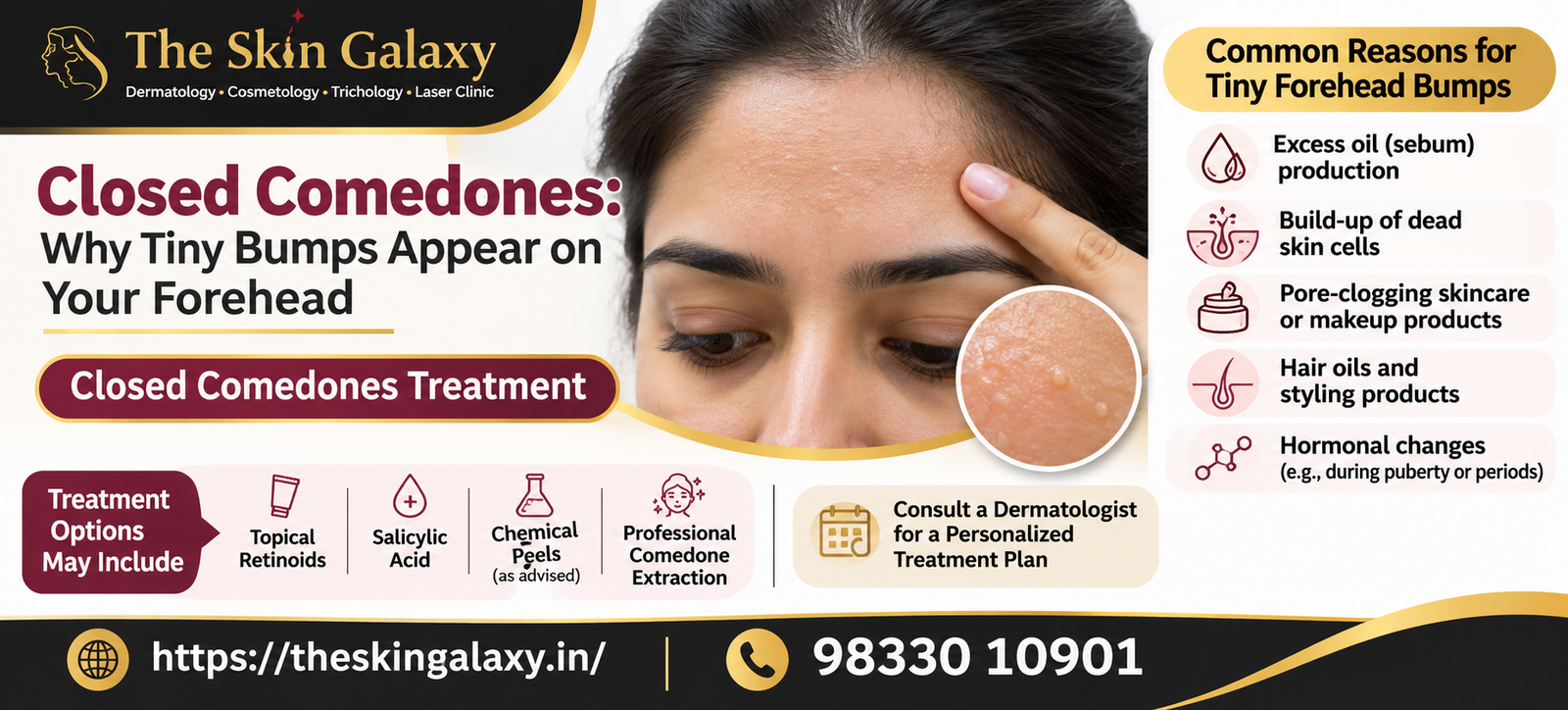
Closed Comedones: Why Tiny Bumps Appear on Your Forehead – The Skin Galaxy
Have you noticed tiny, skin-coloured bumps on your forehead that do not look like typical pimples? These small bumps may feel rough when you touch your skin and can make your forehead appear uneven, even when there is no redness or visible inflammation.
One possible explanation is closed comedones, a common form of acne that develops when pores become blocked with excess oil and dead skin cells.
Closed comedones can affect teenagers and adults, particularly individuals with oily or acne-prone skin. Although they are usually harmless, they can be persistent and may occasionally develop into inflamed acne lesions.
Understanding the causes of these tiny forehead bumps is important before choosing skincare products or treatment methods. Using harsh scrubs, frequently changing skincare products, or attempting to squeeze the bumps can irritate the skin and potentially worsen the condition.
If you are looking for Closed Comedones Treatment, professional dermatological evaluation can help determine whether the bumps are caused by clogged pores or another skin condition.
At The Skin Galaxy, the focus is on understanding individual skin concerns and exploring suitable skincare and dermatological treatment approaches.
In this detailed guide, we will explain what closed comedones are, why they appear on the forehead, how they differ from other skin conditions, and which treatment and prevention methods may help improve skin texture.
1. What Are Closed Comedones?
Closed comedones are small, non-inflammatory acne lesions that form when hair follicles become blocked by a combination of sebum (natural skin oil) and dead skin cells.
Unlike blackheads, which have an open surface, closed comedones have a covered follicular opening.
They often appear as tiny, white or skin-coloured bumps beneath the skin’s surface.
Common Characteristics of Closed Comedones
-
Small, raised bumps on the skin
-
White, pale, or skin-coloured appearance
-
Usually little or no redness
-
Generally painless unless inflammation develops
-
Rough or uneven skin texture
-
Frequently found on the forehead, cheeks, and chin
-
May occur in clusters
Closed comedones are often referred to as whiteheads, although not every small white bump is a closed comedone.
2. Why Do Tiny Bumps Appear on Your Forehead?
The forehead contains numerous sebaceous glands that produce natural skin oil.
When excess sebum combines with dead skin cells inside hair follicles, it can contribute to pore blockage and the formation of closed comedones.
Several factors may increase the likelihood of developing these bumps.
Excess Sebum Production
Sebum helps maintain the skin’s natural protective barrier. However, excessive oil production can contribute to clogged pores, particularly when combined with abnormal shedding of skin cells.
People with oily or combination skin may be more prone to comedonal acne, although closed comedones can occur in other skin types as well.
Accumulation of Dead Skin Cells
The skin continuously sheds old cells as part of its natural renewal process.
When dead skin cells accumulate within hair follicles instead of shedding normally, they may contribute to blockages.
This process, known as abnormal follicular keratinization, plays an important role in acne development.
Heavy or Pore-Clogging Skincare Products
Certain moisturizers, sunscreens, makeup products, and facial oils may contribute to breakouts in susceptible individuals.
Products that feel excessively heavy or greasy may not suit every acne-prone skin type.
Choosing non-comedogenic products may help reduce the likelihood of clogged pores, although no product label guarantees that breakouts will never occur.
Hair Oils and Styling Products
Hair oils, pomades, waxes, and styling creams can transfer from the hairline onto the forehead.
Some products may contribute to acne-like breakouts, especially around the hairline and temples.
This is sometimes called pomade acne.
Keeping hair products away from the forehead and washing away product residue may help.
Hormonal Changes
Hormones, particularly androgens, influence sebum production.
Hormonal changes during puberty, menstrual cycles, and other life stages may contribute to acne in some individuals.
However, forehead bumps alone do not indicate a hormonal disorder.
Sweating and Friction
Sweat, occlusion, and repeated friction from helmets, caps, headbands, or other accessories may aggravate acne-prone skin.
The combination of heat, moisture, and friction can contribute to skin irritation and breakouts.
Gentle cleansing after sweating and reducing unnecessary friction may help.
Genetic Predisposition
A family history of acne can increase an individual’s likelihood of developing acne.
Genetic factors may influence sebum production, inflammatory responses, and other processes involved in acne development.
3. Closed Comedones vs Other Types of Forehead Bumps
Not every tiny bump on the forehead is a closed comedone.
Several skin conditions can cause similar-looking lesions.
| Skin Condition | Common Appearance | Key Difference |
|---|---|---|
| Closed Comedones | Tiny white or skin-coloured bumps | Blocked follicles with a covered opening |
| Blackheads | Small dark spots | Open comedones with exposed follicular contents |
| Milia | Firm, pearly white bumps | Small keratin-filled cysts |
| Folliculitis | Small bumps or pustules around hair follicles | May involve inflammation or infection |
| Malassezia Folliculitis | Often uniform, sometimes itchy bumps | Yeast-associated follicular inflammation |
| Inflammatory Acne | Red papules, pustules, or deeper lesions | More noticeable inflammation |
Important: It is not always possible to distinguish these conditions by appearance alone. Persistent, itchy, painful, or unusual bumps should be assessed by a dermatologist.
4. Closed Comedones Treatment: Effective Dermatological Approaches
The most appropriate Closed Comedones Treatment depends on the severity of the acne, skin sensitivity, age, pregnancy status, and other individual factors.
Treatment generally aims to reduce follicular blockage, prevent new comedones, and improve overall skin texture.
Topical Retinoids
Topical retinoids, such as adapalene and tretinoin, are commonly used to treat comedonal acne.
They help normalize the shedding of skin cells inside hair follicles and reduce the formation of new clogged pores.
Retinoids can cause temporary dryness, peeling, or irritation, especially when first introduced.
A dermatologist can recommend a suitable formulation and application schedule.
Important: Topical retinoids should be avoided during pregnancy and when planning pregnancy unless a qualified clinician advises otherwise.
Salicylic Acid
Salicylic acid is a beta-hydroxy acid commonly included in acne skincare products.
It helps exfoliate the skin and may improve the appearance of clogged pores and mild comedonal acne.
However, excessive use can cause dryness and irritation.
People with sensitive skin should introduce exfoliating products carefully and avoid combining multiple strong active ingredients without guidance.
Benzoyl Peroxide
Benzoyl peroxide is commonly used for acne because of its antimicrobial and anti-inflammatory properties.
It is particularly helpful when inflammatory acne lesions are present alongside comedones.
It may be used as part of a broader acne treatment plan, although topical retinoids are often more directly targeted at comedonal acne.
Benzoyl peroxide can irritate the skin and bleach fabrics.
Azelaic Acid
Azelaic acid may help manage acne and associated post-inflammatory pigmentation.
It can be considered in selected patients, including some individuals who cannot tolerate other acne treatments.
Its suitability and strength should be discussed with a healthcare professional.
Professional Comedone Extraction
In selected cases, a dermatologist or appropriately trained professional may perform comedone extraction using suitable instruments and hygienic techniques.
Professional extraction may help remove certain existing lesions, but it does not prevent new comedones from forming.
Attempting to squeeze or extract closed comedones at home can cause irritation, inflammation, pigmentation changes, and scarring.
Chemical Peels
Superficial chemical peels, including certain salicylic acid or glycolic acid formulations, may be considered as an additional treatment for selected acne patients.
Their effectiveness depends on the formulation, skin type, acne severity, and treatment plan.
Chemical peels should be performed or supervised by appropriately qualified professionals because improper application can cause irritation, burns, or pigmentation problems.
5. How Long Does Closed Comedones Treatment Take?
Closed comedones generally do not disappear immediately.
Many acne treatments require several weeks of consistent use before noticeable improvement occurs.
Some people begin to see changes within approximately 6–8 weeks, while a fuller assessment of treatment response may require around 12 weeks.
The exact timeline depends on the severity of acne, the treatment used, individual skin response, and consistency.
Temporary dryness or irritation can occur when introducing certain active ingredients.
If symptoms worsen significantly or treatment is poorly tolerated, professional advice is recommended rather than increasing product strength independently.
6. Daily Skincare Routine for Closed Comedones on the Forehead
A simple, consistent skincare routine may help support acne treatment.
Morning Skincare Routine
Step 1: Gentle Cleansing
Wash your face with a mild, non-abrasive cleanser to remove excess oil, sweat, and impurities.
Step 2: Suitable Acne Treatment
Use any dermatologist-recommended morning treatment according to the prescribed instructions.
Step 3: Lightweight Moisturizer
Apply a non-comedogenic moisturizer to help maintain the skin barrier.
Step 4: Sunscreen
Use a broad-spectrum sunscreen with SPF 30 or higher, particularly when using acne treatments that may increase skin sensitivity.
Night Skincare Routine
Step 1: Remove Makeup and Sunscreen
Cleanse thoroughly but gently, avoiding harsh rubbing or repeated scrubbing.
Step 2: Apply Prescribed Treatment
If a topical retinoid or another acne medication has been recommended, use it according to professional instructions.
Step 3: Moisturize
Apply a suitable moisturizer to reduce dryness and support the skin barrier.
Avoid introducing multiple exfoliating acids and retinoids simultaneously without professional guidance.
7. Common Mistakes That Can Make Closed Comedones Worse
Certain skincare habits can contribute to irritation or persistent breakouts.
Using Harsh Face Scrubs
Aggressive scrubbing can damage the skin barrier and increase irritation without addressing the underlying follicular blockage.
Squeezing Tiny Forehead Bumps
Attempting to squeeze closed comedones may cause inflammation, skin injury, and post-inflammatory pigmentation.
Over-Exfoliating the Skin
Using multiple exfoliating acids, scrubs, or strong active ingredients too frequently may lead to redness, burning, and dryness.
Frequently Changing Skincare Products
Switching treatments every few days makes it difficult to assess effectiveness and may increase irritation.
Using Heavy Hair Products
Hair oils and styling products that transfer onto the forehead may contribute to breakouts in susceptible individuals.
Skipping Moisturizer
Even oily or acne-prone skin may need moisturizer, especially during acne treatment.
8. Can Closed Comedones Be Prevented?
Not all acne can be prevented, but certain habits may help reduce recurring clogged pores.
-
Cleanse your face gently twice daily and after significant sweating.
-
Choose skincare and makeup products labeled non-comedogenic.
-
Keep heavy hair oils and styling products away from the forehead.
-
Avoid picking, squeezing, or scratching bumps.
-
Use sunscreen suitable for acne-prone skin.
-
Follow prescribed acne treatment consistently.
-
Avoid excessive exfoliation.
-
Clean items that frequently contact the forehead.
-
Seek professional advice if acne remains persistent or worsens.
The goal is to maintain a sustainable skincare routine rather than aggressively trying to remove every visible pore.
9. When Should You Consult a Dermatologist for Closed Comedones?
Occasional mild comedones may respond to suitable skincare and over-the-counter acne products.
However, a dermatology consultation may be helpful if:
-
Forehead bumps persist despite consistent skincare.
-
New comedones continue appearing.
-
Bumps become red, painful, or inflamed.
-
You develop dark marks or scarring.
-
Your skin becomes irritated by acne products.
-
You are unsure whether the bumps are acne, milia, or folliculitis.
-
The condition affects your confidence or quality of life.
Early professional evaluation can help prevent unnecessary experimentation with unsuitable products.
10. Why Consider The Skin Galaxy for Closed Comedones Treatment?
Choosing appropriate skincare and treatment begins with understanding the underlying cause of forehead bumps.
The Skin Galaxy focuses on dermatological skin concerns, including acne-prone skin, uneven skin texture, and related conditions.
Individual Skin Assessment
A professional skin examination can help distinguish closed comedones from other conditions that produce similar-looking bumps.
Personalized Treatment Planning
Treatment may involve topical medications, skincare adjustments, or selected in-clinic procedures depending on individual needs.
Guidance on Suitable Skincare Products
Professional guidance can help patients select cleansers, moisturizers, sunscreens, and acne treatments appropriate for their skin type.
Long-Term Acne Management
Managing comedonal acne often requires consistency and maintenance rather than relying on a single procedure or product.
For specific consultation services, treatment availability, and appointments, contact The Skin Galaxy directly.
Conclusion: Managing Tiny Forehead Bumps Effectively
Closed comedones are a common cause of tiny, skin-coloured bumps on the forehead. They develop when hair follicles become blocked by excess sebum and dead skin cells.
Although these bumps are generally not dangerous, they may persist, affect skin texture, or occasionally progress into inflammatory acne.
Effective Closed Comedones Treatment may involve gentle skincare, topical retinoids, salicylic acid, and selected dermatologist-supervised procedures.
Avoiding harsh scrubs, excessive exfoliation, and unnecessary product changes can also help protect the skin barrier.
If you are experiencing persistent forehead bumps, consulting a qualified dermatologist can help identify the underlying cause and guide appropriate treatment.
The Skin Galaxy can be contacted for information about dermatology consultations and skincare guidance.
Take the First Step Towards Healthier, Smoother-Looking Skin with The Skin Galaxy!
Closed Comedones Treatment Closed Comedones Treatment Closed Comedones Treatment Closed Comedones Treatment Closed Comedones Treatment Closed Comedones Treatment Closed Comedones Treatment Closed Comedones Treatment Closed Comedones Treatment Closed Comedones Treatment Closed Comedones Treatment Closed Comedones Treatment Closed Comedones Treatment Closed Comedones Treatment Closed Comedones Treatment Closed Comedones Treatment Closed Comedones Treatment Closed Comedones Treatment Closed Comedones Treatment Closed Comedones Treatment Closed Comedones Treatment