
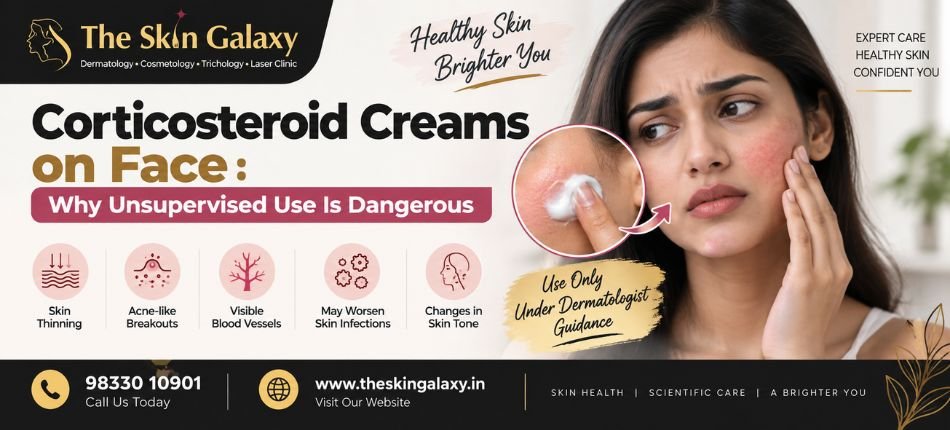
Corticosteroid Creams on Face : Why Unsupervised Use Is Dangerous- The Skin Galaxy
Skin concerns such as redness, itching, rashes, irritation, or allergic reactions can be uncomfortable. Because corticosteroid creams may reduce certain symptoms quickly, some people continue using them without medical supervision or repeatedly apply previously prescribed creams whenever a similar-looking skin problem appears.
However, the facial skin is relatively delicate, and inappropriate or prolonged use of Corticosteroid Creams on Face can cause unwanted effects. The correct steroid, strength, quantity, frequency, and duration depend on the skin condition and area being treated. This is why topical corticosteroids should be used on the face only when recommended by a qualified healthcare professional.
1. What Are Corticosteroid Creams?
Topical corticosteroids are medicines used to reduce inflammation in certain skin conditions. They are available in different forms, including creams, ointments, lotions, gels, and solutions, and come in different strengths or potencies.
A dermatologist may prescribe an appropriate topical corticosteroid after evaluating the skin condition, affected area, severity, age of the patient, and other relevant factors.
The fact that these medicines are applied externally does not mean they are suitable for unrestricted or long-term use.
2. Why Are Steroid Creams Used for Skin Conditions?
Topical corticosteroids can be useful for inflammatory skin conditions when they are appropriately selected and used for the recommended duration.
They may help reduce symptoms such as redness, swelling, itching, and irritation associated with certain dermatological conditions.
However, similar-looking skin problems can have very different causes. A cream suitable for one condition may be ineffective or inappropriate for another, making proper diagnosis important.
3. Why Is Facial Skin More Sensitive to Steroid Creams?
The skin on different areas of the body varies in thickness and sensitivity. Facial skin is relatively thin, and some areas—particularly around the eyes and skin folds—require additional caution.
Because of this, the choice of steroid potency and duration of treatment for facial conditions needs careful consideration.
Using a stronger corticosteroid than necessary or continuing treatment longer than advised can increase the likelihood of local adverse effects.
4. What Can Happen With Unsupervised Steroid Cream Use?
Using corticosteroid creams on the face without medical supervision, especially for prolonged periods, may cause unwanted skin changes. These can include skin thinning, increased sensitivity, visible small blood vessels, acne-like breakouts, and changes in pigmentation. Steroid creams may also temporarily mask or worsen certain skin infections, making the underlying condition harder to identify. Therefore, facial steroid creams should be used only in the appropriate strength and duration as advised by a qualified healthcare professional.
5. Skin Thinning Due to Prolonged Steroid Use
One possible adverse effect of prolonged topical corticosteroid use is skin atrophy, or thinning of the skin.
The skin may become more fragile, and superficial blood vessels may become more noticeable. The risk generally increases with stronger preparations, prolonged use, and application to sensitive areas.
Following the prescribed amount and duration can help reduce unnecessary exposure.
6. Can Steroid Creams Cause Acne-Like Breakouts?
Some people may develop acne-like eruptions after inappropriate or prolonged use of topical corticosteroids on the face.
These eruptions may not behave exactly like ordinary acne, so repeatedly applying additional cosmetic or over-the-counter products without assessment can complicate the condition.
If new bumps or persistent breakouts appear while using a steroid-containing product, medical evaluation is advisable.
7. Can Steroid Creams Hide a Skin Infection?
Yes, corticosteroids can suppress inflammation and temporarily change the appearance of certain infections without treating their underlying cause.
For example, some fungal skin infections can become less typical in appearance when corticosteroids are used inappropriately, potentially making diagnosis more difficult.
This is one reason why self-treating an unexplained facial rash with a steroid cream can be problematic.
8. Steroid-Containing Combination Creams Need Caution
Some creams combine a corticosteroid with antifungal, antibacterial, or other ingredients. People may purchase or reuse such products for different facial concerns because they previously produced quick symptom relief.
However, combination products are not automatically appropriate for every rash or skin problem.
Using them without understanding the underlying diagnosis may temporarily suppress symptoms while allowing the original condition to persist or change.
9. Why Quick Improvement Can Be Misleading
One reason people continue using steroid creams is that redness or itching may improve quickly.
Symptom improvement does not always mean that the underlying condition has been correctly treated. Corticosteroids suppress inflammatory responses, which can make several unrelated skin problems appear temporarily better.
Repeated self-treatment based only on short-term improvement can therefore delay appropriate diagnosis.
10. What Happens When You Stop Using Steroid Cream?
The experience after stopping a topical corticosteroid varies according to the condition, product potency, duration and frequency of use.
Some people may notice that the original skin condition returns. After prolonged or inappropriate use, others may experience significant redness or other symptoms that require medical assessment.
If you have been applying a corticosteroid regularly for an extended period, seek professional advice rather than making major changes to treatment without guidance.
11. Avoid Using Someone Else’s Prescription
A cream prescribed to another family member or friend may not be appropriate for your skin condition.
Even if two rashes look similar, they can have completely different causes. Treatment depends on diagnosis, location, severity, age, medical history, and other factors.
Prescription skin medicines should therefore not be shared.
12. Check Your Skincare Products
Some individuals may unknowingly use corticosteroid-containing products because they have not checked the ingredients or are using an unlabelled or inadequately labelled product.
If a product produces unusually rapid changes or you are uncertain about its ingredients, check the label and seek professional advice.
Avoid using unidentified creams on the face, particularly for prolonged periods.
13. When Should You Consult a Dermatologist?
Consider consulting a dermatologist if you have persistent facial redness, itching, rash, acne-like eruptions, pigmentation changes, burning, increased sensitivity, or a skin condition that repeatedly returns after stopping a cream.
You should also seek medical guidance if you have been using a corticosteroid-containing cream on your face for a prolonged period without supervision.
A dermatologist can evaluate the condition and determine whether the cream should be continued, changed, or replaced with another treatment.
14. Safe Use of Corticosteroid Creams on the Face
When a topical corticosteroid is medically indicated for a facial skin condition, follow the prescribed instructions carefully.
Use only the recommended product, apply the advised quantity, follow the specified frequency, and do not continue it longer than directed.
Do not assume that a stronger steroid will provide better treatment. For facial skin, appropriate selection and controlled use are especially important.
15. How The Skin Galaxy Can Help
At The Skin Galaxy, skin concerns can be assessed to understand their possible cause before an appropriate treatment plan is recommended.
Professional dermatological evaluation is particularly important when a facial condition is persistent, recurrent, worsening, or has been treated repeatedly with steroid-containing products.
Individual assessment can help distinguish between conditions that may look similar but require different treatments.
Conclusion
Corticosteroid Creams on Face can be useful medicines for specific dermatological conditions when appropriately prescribed and monitored. Problems arise when they are used for the wrong condition, applied too frequently, used at excessive potency, or continued for prolonged periods without supervision.
Avoid self-prescribing or repeatedly reusing old steroid creams for new facial concerns. Proper diagnosis and professional guidance can help ensure that facial skin conditions are treated appropriately while minimizing unnecessary risks.
Corticosteroid Creams on Face Corticosteroid Creams on Face Corticosteroid Creams on Face Corticosteroid Creams on Face Corticosteroid Creams on Face Corticosteroid Creams on Face Corticosteroid Creams on Face Corticosteroid Creams on Face Corticosteroid Creams on Face Corticosteroid Creams on Face Corticosteroid Creams on Face Corticosteroid Creams on Face