
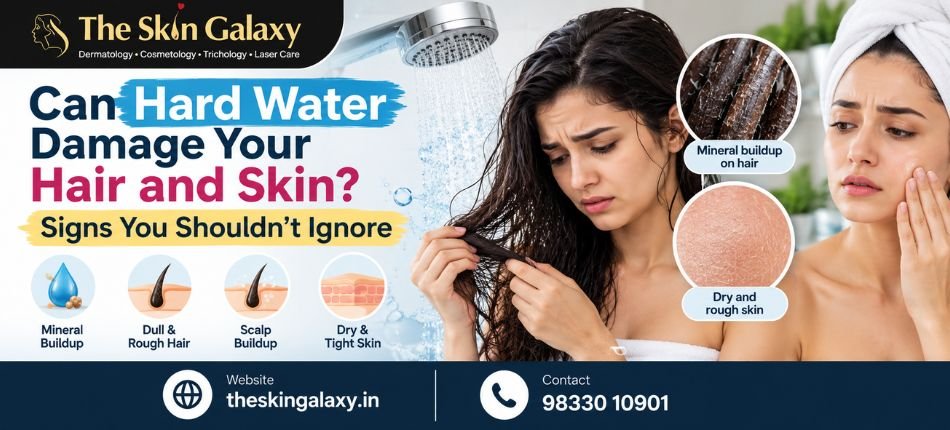
Can Hard Water Damage Your Hair and Skin? Signs You Shouldn’t Ignore – The Skin Galaxy
If your hair feels rough even after conditioning, your scalp develops frequent buildup, or your skin feels dry and uncomfortable despite following a regular care routine, the water you use every day could be one factor worth considering. Hard water damage to hair and skin can occur when repeated exposure to mineral-rich water leaves deposits on the hair, scalp, and skin.
Hard water contains relatively high levels of dissolved minerals, particularly calcium and magnesium. Hard water itself is not generally considered a health hazard, but its interaction with cleansers, shampoos, and the surface of the hair and skin can affect how they feel and behave.
Understanding the possible effects of hard water can help you adjust your routine instead of repeatedly changing products without knowing what may be contributing to the problem.
What Is Hard Water?
Hard water is water containing relatively high concentrations of dissolved minerals, mainly calcium and magnesium. The amount varies depending on the local water source and treatment system.
When hard water is used regularly for bathing and hair washing, minerals can accumulate on surfaces. You may notice similar deposits around taps, showerheads, bathroom tiles, or buckets.
On the hair and skin, the effect is less obvious, but repeated exposure may contribute to changes in texture, cleansing effectiveness, and moisture balance.
How Does Hard Water Affect Your Hair?
Hard water contains minerals such as calcium and magnesium that may gradually build up on the hair. This buildup can make hair feel rough, dry, dull, or difficult to manage. It may also affect how well shampoo and conditioner work. Over time, increased dryness and tangling can make the hair more prone to breakage.
Can Hard Water Cause Hair Fall?
This is an important distinction. Hard water should not automatically be assumed to be the cause of hair loss.
Mineral buildup, dryness, and changes in hair texture may make the hair more difficult to manage. Increased friction and tangling can potentially contribute to hair breakage, which may sometimes be mistaken for hair falling from the root.
Persistent or excessive hair shedding, however, can have many other causes, including nutritional deficiencies, hormonal changes, stress, certain illnesses, medications, hereditary hair loss, and scalp disorders.
If you are experiencing noticeable or ongoing hair fall, a dermatologist can help determine the actual cause rather than attributing it to water quality alone.
Does Hard Water Cause Scalp Buildup?
Hard water may contribute to scalp buildup when minerals combine with natural oils and residues from hair-care products. The scalp may feel coated or greasy even after regular washing. Some people may also notice flakes or hair becoming flat near the roots. However, persistent scalp problems can have other causes and should be evaluated if they continue.
How Can Hard Water Affect Your Skin?
Hard water can interact with soaps and cleansers, making them harder to rinse completely from the skin. Repeated exposure may leave the skin feeling dry, rough, tight, or uncomfortable after bathing. People with naturally dry or sensitive skin may notice these effects more easily. A gentle cleanser and regular moisturization can help support the skin barrier.
Can Hard Water Damage the Skin Barrier?
The skin barrier helps retain moisture while protecting the skin from environmental irritants. Frequent washing, hot showers, harsh cleansers, over-exfoliation, and unsuitable skincare products can all affect this barrier.
Hard water may be an additional environmental factor because mineral-rich water can alter cleansing and leave deposits on the skin.
If your skin regularly feels tight immediately after bathing, it may be useful to look at the complete routine rather than focusing on water alone.
For example, consider the temperature of your shower, how long you bathe, the cleanser you use, how often you exfoliate, and whether you moisturize afterward.
7 Signs Hard Water May Be Affecting Your Hair and Skin
Hard water may be worth investigating if you repeatedly notice several of these changes:
1. Hair feels rough immediately after washing
Your hair may feel less smooth even after using conditioner.
2. Hair has lost its natural shine
Mineral deposits can contribute to a dull or coated appearance.
3. Shampoo does not lather easily
Hard water can affect the way cleansing products perform.
4. Scalp buildup returns quickly
Your scalp may feel coated even though you wash it regularly.
5. Skin feels tight after bathing
This may indicate excessive dryness or disruption from your cleansing routine.
6. Products seem less effective than before
Shampoo, conditioner, or cleansers may behave differently in mineral-rich water.
7. You see mineral deposits around bathroom fixtures
White or chalky deposits on taps and showerheads are a useful clue that your water may be hard.
Having one of these signs does not prove that hard water is responsible, but several occurring together may justify checking your water quality.
How Can You Protect Your Hair From Hard Water?
If you live in an area with hard water, you do not necessarily need to completely change your hair-care routine.
Start with simple measures.
1. Use a Gentle Shampoo
Choose a shampoo appropriate for your scalp and hair type. Excessive washing with harsh cleansers can worsen dryness.
2. Consider Occasional Clarifying
A clarifying or chelating product may help remove certain deposits and product buildup. However, these products are not necessarily suitable for frequent use and may leave some hair types feeling dry.
A dermatologist can advise you if you are unsure which product is appropriate.
3. Condition the Hair Properly
Applying conditioner primarily to the lengths and ends can help improve manageability and reduce friction.
4. Limit Excessive Heat Styling
If your hair already feels dry or rough, frequent straightening, curling, or high-temperature blow-drying can add further stress to the hair shaft.
5. Avoid Constant Product Switching
Changing shampoos every few days makes it difficult to understand what is actually helping. Give an appropriate routine enough time unless a product is clearly causing an adverse reaction.
How Can You Protect Your Skin From Hard Water?
A simple, barrier-friendly skincare routine can be useful if your skin feels dry after bathing.
Use lukewarm rather than very hot water, keep showers reasonably short, and choose a gentle cleanser suitable for your skin type. Avoid aggressive scrubbing and unnecessary exfoliation.
After bathing, gently pat the skin dry and apply moisturizer while the skin is still slightly damp. This can help reduce moisture loss.
People with sensitive or persistently dry skin may benefit from dermatologist-guided product selection rather than experimenting with multiple active ingredients.
Should You Install a Water Filter or Softener?
Before investing in a solution, it helps to understand the difference between water filtration and water softening.
A typical shower filter may reduce certain substances depending on its design, but it does not necessarily remove the calcium and magnesium responsible for water hardness.
A true water-softening system is specifically designed to reduce hardness minerals.
If you suspect hard water, consider testing the water hardness first. This gives you objective information before spending money on filters, shower attachments, or whole-home systems.
Hard Water vs Other Hair and Skin Problems
Not every change in your hair or skin is caused by hard water.
For example, persistent hair shedding could be associated with nutritional, hormonal, hereditary, medical, or scalp-related factors. Likewise, recurring skin dryness or irritation may have causes unrelated to water quality.
This is why self-diagnosing hard water damage to hair and skin based only on symptoms can sometimes delay identification of the actual problem.
When Should You Consult a Dermatologist?
Consider seeking professional evaluation if changes persist despite adjusting your routine, particularly if you notice significant hair shedding, progressive thinning, persistent scalp scaling, recurring skin irritation, or changes that are becoming more noticeable over time.
A dermatologist can assess your scalp, hair, and skin and help distinguish between environmental factors such as water quality and conditions that require specific treatment.
Final Thoughts
Hard water damage to hair and skin is usually less about one dramatic change and more about repeated exposure that may influence hair texture, scalp buildup, cleansing effectiveness, and skin dryness.
If your hair suddenly feels rough, your scalp develops frequent buildup, or your skin feels unusually tight after bathing, consider water quality as one possible factor—not the only explanation.
Small changes such as gentle cleansing, proper conditioning, regular moisturization, avoiding excessively hot water, and checking your water hardness may help. If symptoms continue, professional evaluation can identify the underlying cause and guide you toward a routine appropriate for your hair and skin.
The Skin Galaxy provides dermatologist-guided evaluation and personalized care for a range of skin, scalp, and hair concerns.