
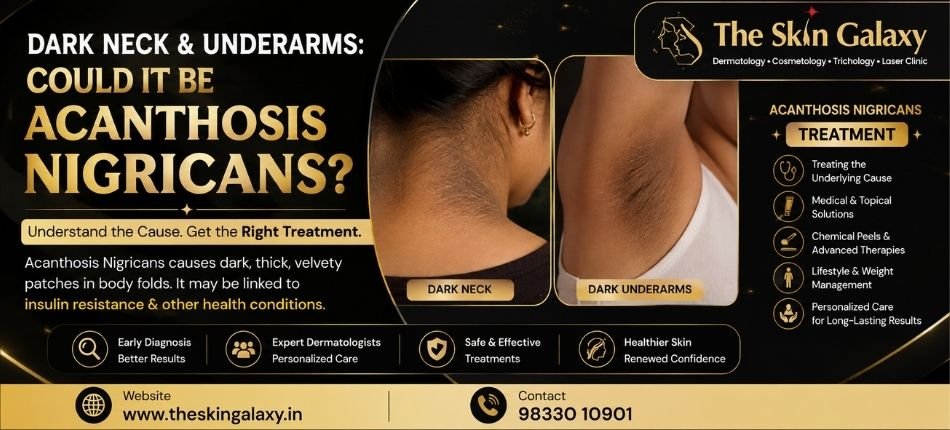
Dark Neck and Underarms: Could It Be Acanthosis Nigricans? | Acanthosis Nigricans Treatment – The Skin Galaxy
Introduction
Darkening around the neck and underarms is often assumed to be caused by tanning, friction, sweating, or inadequate cleansing. However, when the skin becomes noticeably darker, thicker, and velvety in texture, it may be a condition known as acanthosis nigricans.
Acanthosis nigricans is not simply a cosmetic pigmentation problem. In some people, it can be associated with an underlying health issue, particularly insulin resistance. This is why repeatedly scrubbing the area or trying different skin-lightening products without understanding the cause may not provide the desired improvement.
Appropriate Acanthosis Nigricans Treatment begins with identifying why the skin changes have developed. Treatment may involve addressing an underlying condition along with dermatological measures to improve pigmentation and skin texture.
What Is Acanthosis Nigricans?
Acanthosis nigricans is a skin condition that causes areas of the skin to become darker, thicker, and velvety in texture. It commonly appears on the neck, underarms, groin, and other skin folds. The changes usually develop gradually and may sometimes be accompanied by small skin tags. It is not simply caused by dirt or poor hygiene and may indicate an underlying health issue.
What Does Acanthosis Nigricans Look Like?
The appearance can vary between individuals, but typical changes may include:
Dark pigmentation: The affected area may appear brown, greyish, or darker than the surrounding skin.
Velvety texture: Instead of simply looking darker, the skin may feel unusually soft, thick, or velvety.
Skin thickening: The folds and lines of the skin may become more prominent.
Gradual development: In many cases, the changes develop slowly rather than appearing overnight.
Some patients may also notice skin tags around the affected areas.
Why Does Acanthosis Nigricans Occur?
Acanthosis nigricans is commonly associated with insulin resistance, which can stimulate changes in skin cells and lead to thickening and pigmentation. It may also be associated with excess body weight, diabetes or prediabetes, PCOS, certain hormonal conditions, medications, or genetic factors. In rare cases, sudden or widespread acanthosis nigricans may be linked to other medical conditions. Identifying the underlying cause is therefore an important part of treatment.
Is a Dark Neck Always Acanthosis Nigricans?
No. Having a dark neck does not automatically mean that you have acanthosis nigricans.
Pigmentation around the neck can also develop due to friction, irritation, previous inflammation, sun exposure, certain skin conditions, or other causes.
A dermatologist can evaluate the colour, texture, distribution, duration, and associated symptoms to determine whether the pigmentation is consistent with acanthosis nigricans.
Correct diagnosis is important because different causes of pigmentation require different treatments.
Can Dark Underarms Be Acanthosis Nigricans?
Yes, the underarms are among the common areas where acanthosis nigricans may develop.
However, underarm pigmentation can also occur because of repeated shaving, friction, irritation from personal-care products, inflammatory skin conditions, or post-inflammatory pigmentation.
If underarm darkness is accompanied by thickening or a velvety texture, or similar pigmentation is present around the neck or other body folds, professional evaluation may be helpful.
What Is the Connection Between Insulin Resistance and Acanthosis Nigricans?
Insulin resistance occurs when the body’s cells do not respond to insulin as effectively as they should.
As a result, the body may produce higher levels of insulin to maintain normal blood glucose regulation. Elevated insulin levels can stimulate certain skin cells and contribute to the changes seen in acanthosis nigricans.
This is why the condition can sometimes serve as a visible clue that further metabolic assessment may be appropriate.
A dermatologist may recommend consultation with a physician or appropriate blood investigations when an underlying metabolic condition is suspected.
Acanthosis Nigricans Treatment: What Are the Options?
Effective Acanthosis Nigricans Treatment depends primarily on its underlying cause.
There is no single cream or procedure that is appropriate for every patient.
1. Treating the Underlying Cause
Addressing the associated medical condition is often one of the most important parts of treatment.
If insulin resistance, diabetes, PCOS, weight-related metabolic changes, medication use, or another condition is contributing to the skin changes, appropriate medical management may help.
A dermatologist may work alongside another medical specialist when necessary.
2. Weight and Lifestyle Management
When excess body weight and insulin resistance are contributing factors, medically appropriate lifestyle changes may be recommended.
Balanced nutrition, regular physical activity, adequate sleep, and weight management may support overall metabolic health.
These changes should be considered part of overall health management rather than a quick cosmetic treatment for pigmentation.
3. Topical Treatment
Depending on the patient’s skin type and severity, a dermatologist may prescribe topical treatments intended to improve pigmentation or excessive skin thickening.
These may include certain keratolytic or pigment-targeting ingredients.
Patients should avoid self-prescribing strong peeling agents or bleaching creams because inappropriate use can cause irritation and worsen pigmentation.
4. Chemical Peels
Dermatologist-supervised chemical peels may be considered for selected patients to improve pigmentation and skin texture.
The type and strength of peel should be chosen according to the patient’s skin type and condition.
Chemical peels do not replace treatment of an underlying metabolic cause.
5. Other Dermatological Procedures
In selected cases, dermatologists may consider additional procedures for persistent pigmentation or textural changes.
Suitability varies from patient to patient, and expectations should be realistic because recurrence can occur when the underlying contributing factor remains present.
Why Scrubbing a Dark Neck May Make Things Worse
Many people believe that a dark neck means dirt has accumulated on the skin.
As a result, they repeatedly scrub the area using loofahs, brushes, scrubs, lemon, baking soda, or other home remedies.
Aggressive friction can irritate the skin and may worsen pigmentation.
If the darkness is due to acanthosis nigricans, scrubbing cannot treat the underlying reason for the skin changes.
When Should You See a Dermatologist?
Consider consulting a dermatologist when:
- Neck or underarm pigmentation is persistent
- Skin becomes thick or velvety
- Pigmentation is gradually increasing
- Multiple body folds are affected
- Skin changes appear unexpectedly
- Home treatments have caused irritation
- You are unsure why the pigmentation has developed
Sudden or rapidly developing widespread changes should receive medical attention.
Can Acanthosis Nigricans Completely Disappear?
Improvement depends on the cause, severity, duration, and response to treatment.
When an underlying contributing factor can be effectively managed, skin appearance may gradually improve. Dermatological treatment can also help address pigmentation and texture in appropriate patients.
However, results vary, and improvement is often gradual rather than immediate.
Conclusion
A dark neck or dark underarms should not automatically be dismissed as tanning or poor hygiene. When the skin becomes dark, thick, and velvety, acanthosis nigricans may be one possible explanation.
Effective Acanthosis Nigricans Treatment requires more than simply trying skin-lightening products. Identifying and addressing the underlying cause is an important part of long-term management.
If you are concerned about persistent darkening around your neck, underarms, or other body folds, consult The Skin Galaxy for appropriate dermatological evaluation and personalized treatment guidance.
Acanthosis Nigricans Treatment Acanthosis Nigricans Treatment Acanthosis Nigricans Treatment Acanthosis Nigricans Treatment Acanthosis Nigricans Treatment Acanthosis Nigricans Treatment Acanthosis Nigricans Treatment Acanthosis Nigricans Treatment Acanthosis Nigricans Treatment Acanthosis Nigricans Treatment Acanthosis Nigricans Treatment Acanthosis Nigricans Treatment